AI Solutions for Small Businesses: Industry-by-Industry Guide for 2026
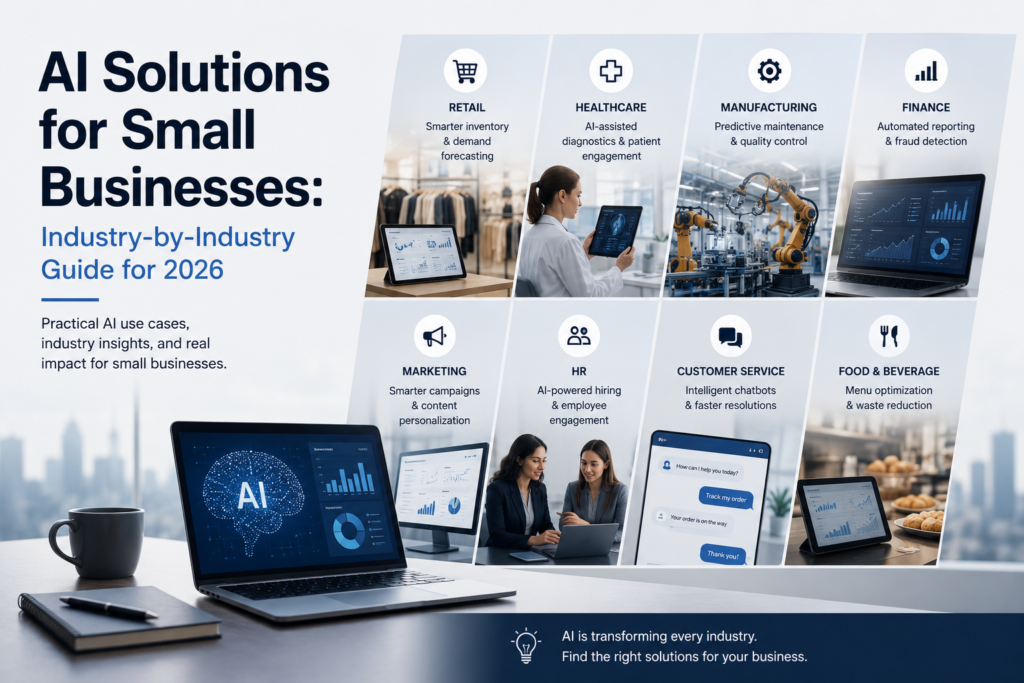
Artificial intelligence is no longer limited to large enterprises with dedicated data-science teams and substantial technology budgets.
Small businesses can now use AI to respond to customers faster, automate repetitive administration, improve decision-making, reduce manual data entry, and give employees more time for higher-value work
But the right AI solution depends on the business.
A healthcare clinic has different priorities from a retail store. A law firm needs strict oversight around legal work, while a home-services company may gain immediate value from faster lead capture and appointment scheduling. A small manufacturer may benefit more from quality analytics or predictive maintenance than from a customer-service chatbot.
That is why the best starting question is not:
“Which AI tool should my business buy?”
It is:
“Which business problem should AI help us solve first?”
This guide examines practical AI opportunities across 20 small-business industries. For each industry, it covers:
- The most common business problems
- Relevant AI solutions
- Practical automation opportunities
- A recommended starting point
- Important cautions
The goal is not to automate everything.
The goal is to identify one valuable workflow, apply the appropriate AI capability, maintain suitable human oversight, and measure the business result.
AI Adoption in Small Businesses
Small-business AI adoption is increasing, but adoption does not necessarily mean deep operational integration.
The OECD’s 2025 SME digitalisation survey reported that 39% of surveyed SMEs were using AI applications, up from 26% in 2024. Adoption varies significantly by company size, sector, country, digital maturity, and access to skills.
Early-stage adoption is often concentrated in relatively simple activities such as content generation, drafting, translation, customer communication, and administrative support.
The next stage is more operational: connecting AI to CRM, accounting, helpdesk, scheduling, inventory, and project-management systems.
This distinction matters.
Using an AI assistant to draft an email is useful, but it is not the same as building a reliable workflow such as:
Customer inquiry → AI classification → System action → Human escalation
For most small businesses, the practical opportunity in 2026 is not building a custom foundation model.
It is connecting existing business systems with AI capabilities that can:
- Interpret information
- Generate drafts
- Classify requests
- Retrieve knowledge
- Recommend actions
- Trigger defined next steps
- Escalate exceptions to employees
Business-First AI Principle
Don’t start with the AI tool. Start with the business workflow.
A useful AI implementation should improve something the business already cares about: response time, operating cost, revenue, customer experience, employee capacity, accuracy, or risk.
Quick Overview: AI Solutions by Industry
| Industry | Common AI solution areas | Strong starting point |
|---|---|---|
| Healthcare clinics | Scheduling, intake, reminders, documentation | Appointment management |
| Retail stores | Forecasting, recommendations, service, marketing | Inventory or retention |
| Law firms | Intake, document processing, research support | Internal drafting |
| Manufacturing | Quality control, maintenance, reporting | Analytics and reporting |
| Real estate agencies | Lead qualification, matching, follow-up | Lead response |
| Accounting firms | Bookkeeping, extraction, reporting | Transaction categorisation |
| Restaurants and food businesses | Reservations, demand, reviews, marketing | Reservations and communication |
| Professional services | Proposals, reporting, scheduling, follow-up | Repetitive documents |
| Marketing agencies | Content, reporting, campaign workflows | Content and reporting |
| Recruitment agencies | Screening, sourcing, scheduling | Recruiter-assisted screening |
| Education and training | Content, learner support, administration | Content and onboarding |
| Travel and tourism | Inquiries, itineraries, bookings, reviews | FAQs and itinerary drafts |
| Automotive services | Booking, reminders, updates, follow-up | Appointment scheduling |
| Construction | Estimates, reporting, documentation | Documentation and estimates |
| Insurance agencies | Lead qualification, documents, support | Lead response |
| Financial services | Onboarding, reporting, communication | Reporting and client service |
| Beauty and wellness | Booking, reminders, retention, marketing | Appointment management |
| Home services | Lead capture, scheduling, quotations | Lead intake |
| E-commerce | Service, recommendations, order support | FAQs and order status |
| IT and technology services | Ticket triage, knowledge, documentation | Support triage |
1. Healthcare Clinics
Business Problems
Small healthcare clinics often operate with limited front-desk capacity.
Staff may spend significant time answering calls, booking and rescheduling appointments, responding to routine questions, collecting intake information, and sending reminders.
No-shows and inconsistent post-visit follow-up can reduce revenue and waste appointment capacity. Clinicians may also spend excessive time documenting consultations after the patient interaction has ended.
AI Solutions
AI can support:
- Appointment booking and rescheduling
- Clinic-hours, location, and service FAQs
- Patient intake and information collection
- Appointment reminders
- Post-visit follow-up
- Patient communication
- Clinical documentation assistance
- Draft visit summaries and educational material
AI medical scribes can also transcribe conversations and structure draft clinical notes for clinician review.
Automation Opportunity
A practical administrative workflow could be:
Patient inquiry → AI intake → Appointment booking → Reminder → Visit → Follow-up
A clinic could also use AI to identify patients who have not completed forms, generate draft visit summaries, or send approved post-visit instructions.
Recommended Starting Point
Start with non-clinical administrative processes, particularly appointment scheduling, reminders, FAQs, and intake.
Choose a healthcare-focused provider with appropriate security controls, access management, data-retention policies, auditability, and contractual protections.
Measure outcomes such as:
- Reduced no-shows
- Fewer front-desk calls
- Faster appointment response
- Reduced administrative hours
Important Caution
AI should remain assistive.
Diagnosis, treatment recommendations, prescriptions, and clinical judgments should remain under qualified professional control.
Health information is highly sensitive. Businesses should understand where data is stored, who can access it, whether it is used for model training, how long it is retained, and what happens during a security incident.
2. Retail Stores
Business Problems
Retail businesses must balance customer demand, inventory, pricing, marketing, and customer experience.
Stockouts can result in lost sales, while excess inventory ties up cash and may eventually require markdowns.
Smaller retailers may also have fragmented customer information across point-of-sale systems, websites, marketplaces, social channels, and messaging platforms.
AI Solutions
AI can help with:
- Demand forecasting
- Inventory optimisation
- Product recommendations
- Customer segmentation
- Customer-service automation
- Personalised marketing
- Promotion analysis
- Review and feedback analysis
Automation Opportunity
A practical inventory workflow might be:
Sales data → AI demand analysis → Reorder recommendation → Staff approval → Inventory action
Retailers can also automate abandoned-cart recovery, customer win-back campaigns, product tagging, and responses to common product questions.
Recommended Starting Point
Choose one measurable problem, such as:
- Excessive stockouts
- Slow customer response
- Weak repeat purchases
- Poor inventory visibility
Start with a limited product category or customer segment.
Measure stock availability, recovered revenue, conversion, or repeat purchases.
Important Caution
Forecasting is only as reliable as the data behind it.
Seasonal anomalies, promotions, incomplete sales records, and new products can produce misleading recommendations.
AI should recommend actions while purchasing and pricing decisions retain appropriate human oversight.
3. Law Firms
Business Problems
Small law firms often spend substantial time reviewing documents, drafting standard correspondence, researching legal information, managing client intake, performing conflict checks, and following up with prospective clients.
These processes are document-heavy and repetitive, but they are also highly sensitive because errors can create legal, financial, and reputational consequences.
AI Solutions
AI can assist with:
- Document summarisation
- Contract comparison
- Clause identification
- Legal research support
- Drafting from approved templates
- Client intake
- Matter qualification
- Follow-up communication
- Internal knowledge retrieval
Automation Opportunity
A controlled intake workflow might be:
Client inquiry → Intake form → Information capture → Conflict-check workflow → Lawyer review → Matter creation
AI can also generate first drafts of standard letters, clause summaries, or client updates using approved templates and firm knowledge.
Recommended Starting Point
Begin with internal drafting, document summarisation, or knowledge retrieval.
These use cases allow lawyers to review AI output before it reaches a client or court.
Create approved templates, source libraries, review rules, and escalation procedures before introducing broader automation.
Important Caution
AI-generated legal content is a draft, not legal advice.
It can produce inaccurate citations, omit important facts, misunderstand jurisdiction, or rely on outdated information.
Lawyers should verify facts, sources, dates, calculations, and citations.
Client confidentiality and vendor data-handling terms also require careful review.
4. Manufacturing
Business Problems
Small manufacturers may face:
- Scrap and rework
- Inconsistent quality
- Unplanned downtime
- Equipment maintenance challenges
- Production bottlenecks
- Time-consuming reporting
Many manufacturers have valuable operational data but lack the systems or resources to use it effectively.
AI Solutions
AI can support:
- Visual quality inspection
- Defect classification
- Predictive maintenance
- Anomaly detection
- Production analytics
- Demand and capacity planning
- Maintenance reporting
- Root-cause analysis
Automation Opportunity
A controlled operational workflow could be:
Production data → AI analysis → Anomaly detection → Alert → Human inspection → Maintenance or process action
AI can also convert production data into shift reports, classify defects, identify recurring causes, and recommend maintenance priorities.
Recommended Starting Point
Start with data quality, reporting, and analytics.
Before deploying predictive models, ensure equipment data, maintenance logs, quality records, and production measurements are consistent enough to support reliable analysis.
Then pilot predictive maintenance or computer vision on one production line, product family, or critical asset.
Important Caution
False alarms can create unnecessary downtime, while missed alarms can create safety and production risks.
AI should not replace established quality and safety controls during an early pilot.
5. Real Estate Agencies
Business Problems
Real estate agencies often receive inquiries from:
- Websites
- Listing portals
- Social media
- Phone calls
- Messaging applications
Leads may be lost because agents cannot respond quickly enough.
Property matching, qualification, listing preparation, and repetitive follow-up can also consume significant time.
AI Solutions
AI can assist with:
- Lead capture
- Lead qualification
- Lead scoring
- Property matching
- Listing descriptions
- Follow-up messages
- Customer segmentation
- Viewing coordination
- Marketing content
Automation Opportunity
A lead-management workflow could be:
Lead inquiry → AI qualification → Property matching → Agent notification → Follow-up
The system can collect budget, preferred location, property type, timing, and other requirements before passing the lead to an agent.
Recommended Starting Point
Start at the top of the sales funnel.
Faster response, better qualification, and more consistent follow-up are usually easier to measure than advanced valuation systems.
Track:
- Response time
- Qualified leads
- Viewings booked
- Conversion rate
Important Caution
AI-generated property descriptions must be checked for accuracy.
AI should not invent amenities, misrepresent locations, or make unsupported claims.
Property valuation systems should be treated as decision-support tools rather than authoritative valuations.
6. Accounting Firms
Business Problems
Accounting firms process large volumes of:
- Invoices
- Receipts
- Statements
- Transactions
- Payroll records
- Tax-related documents
Manual data entry, transaction categorisation, reconciliation, exception handling, and client communication can consume significant staff time.
AI Solutions
AI can assist with:
- Document extraction
- Invoice processing
- Transaction categorisation
- Reconciliation support
- Anomaly detection
- Cash-flow analysis
- Management reporting
- Client communication
- Meeting summaries
Automation Opportunity
A typical workflow could be:
Financial document → AI extraction → Transaction classification → Exception queue → Accountant review
AI can also prepare first drafts of management reports, identify unusual transactions, and summarise changes in a client’s financial position.
Recommended Starting Point
Begin with document processing and transaction categorisation using capabilities already integrated into established accounting platforms.
Use confidence thresholds.
High-confidence, low-risk transactions may be processed automatically, while unusual, material, or compliance-sensitive items should enter an exception queue.
Important Caution
Misclassified transactions can affect tax filings, financial reporting, and business decisions.
Human review should remain mandatory for material, unusual, or legally significant transactions.
7. Restaurants and Food Businesses
Business Problems
Restaurants deal with:
- Fluctuating demand
- Food waste
- Reservations
- No-shows
- Customer questions
- Online reviews
- Marketing demands
- Fragmented customer communication
AI Solutions
AI can support:
- Reservation management
- Customer-service responses
- Demand forecasting
- Review analysis
- Menu and promotion content
- Customer segmentation
- Staff scheduling support
- Inventory and preparation planning
Automation Opportunity
A customer-communication workflow could be:
Reservation request → Confirmation → Reminder → Visit → Review request
AI can also help prepare daily demand estimates, generate preparation lists, classify customer feedback, and create promotional content.
Recommended Starting Point
Start with reservations, reminders, and customer communication.
Useful metrics include:
- No-show rate
- Booking response time
- Reservation volume
- Review response time
- Repeat visits
Important Caution
AI-generated replies should not be published automatically for sensitive complaints or serious service failures.
Customer trust should take priority over aggressive optimisation.
8. Professional Services
This category includes consultants, coaches, specialist advisers, business-service providers, and other knowledge-based firms.
Business Problems
Professional-service firms often spend too much time preparing:
- Proposals
- Reports
- Presentations
- Meeting summaries
- Client updates
- Invoices
- Follow-ups
Knowledge may also be scattered across employees, documents, email, and project tools.
AI Solutions
AI can help with:
- Proposal drafting
- Report generation
- Meeting summaries
- Client communication
- Lead scoring
- Follow-up reminders
- Knowledge retrieval
- Project-status updates
- Document comparison
Automation Opportunity
A practical workflow is:
Client inquiry → Intake → Proposal draft → Human approval → Project creation
Recurring client reports can also be assembled from structured project data, with AI preparing an explanatory narrative for review.
Recommended Starting Point
Identify the document or communication created most frequently.
Standardise the template, required data, approval process, and tone before introducing AI.
Important Caution
AI-generated proposals can become generic if they are not grounded in the firm’s expertise, client context, and previous work.
Confidential client information should not be placed into unapproved consumer AI tools.
9. Marketing Agencies
Business Problems
Marketing agencies must produce content across multiple channels while developing campaigns, managing approvals, analysing performance, and preparing client reports.
The challenge is not simply creating more content.
It is maintaining quality, differentiation, strategic consistency, and measurable outcomes across multiple accounts.
AI Solutions
AI can assist with:
- Content drafts
- Social media ideas
- Ad-copy variations
- Video and podcast scripts
- Campaign analysis
- Client reporting
- Performance summaries
- Audience segmentation
- Workflow coordination
Automation Opportunity
A content workflow could be:
Content idea → AI draft → Human approval → Scheduling → Performance analysis
A reporting workflow could connect advertising and analytics platforms to assemble monthly reports and highlight meaningful changes.
Recommended Starting Point
Automate repetitive formats such as:
- First drafts
- Content repurposing
- Data collection
- Standard reporting
Keep strategy, positioning, creative direction, brand judgment, client relationships, and final approvals human-led.
Important Caution
Large volumes of AI-generated content can produce sameness, factual errors, brand inconsistency, or lower-quality creative work.
10. Recruitment Agencies
Business Problems
Recruiters may spend considerable time:
- Sourcing candidates
- Reviewing resumes
- Matching experience to job descriptions
- Scheduling interviews
- Updating candidates
- Maintaining recruitment records
AI Solutions
AI can assist with:
- Resume parsing
- Candidate search
- Job-description analysis
- Match suggestions
- Interview scheduling
- Candidate communication
- Recruitment pipeline updates
- Interview-note summarisation
Automation Opportunity
A controlled workflow might be:
Candidate application → Resume parsing → Match analysis → Recruiter review → Interview scheduling
AI can identify potentially relevant experience and surface candidates for recruiter review.
Recommended Starting Point
Start with resume parsing, scheduling, and routine communication.
Track:
- Recruiter hours saved
- Time to shortlist
- Candidate response time
- Quality of shortlist
Important Caution
Automated candidate evaluation can reproduce or amplify bias in historical hiring data or job descriptions.
Human review, documented decision rules, testing, and appropriate override mechanisms are essential.
Employment-related AI applications can also be subject to additional regulatory requirements depending on the jurisdiction. Businesses operating in the European Union should review the applicable requirements under the EU AI Act.
11. Education and Training
Business Problems
Training providers, coaching businesses, and educational organisations spend time creating:
- Lessons
- Quizzes
- Assessments
- Learner communications
- Onboarding material
- Support responses
Online programmes may also experience low engagement and stalled learners.
AI Solutions
AI can support:
- Lesson and curriculum drafting
- Quiz generation
- Assessment drafts
- Learner support
- Personalised learning paths
- Progress analysis
- Engagement campaigns
- Administrative communication
- Translation and accessibility support
Automation Opportunity
A learner-engagement workflow could be:
Enrollment → Onboarding → Progress monitoring → Reminder → Re-engagement
AI can identify learners who have stalled, draft an appropriate reminder, suggest resources, and notify a tutor when human intervention is needed.
Recommended Starting Point
Start with content creation, onboarding, FAQs, and administrative communication.
Educators should define learning objectives, review generated material, and remain responsible for curriculum quality.
Important Caution
Do not delegate academic judgment, grading, safeguarding, or sensitive learner decisions entirely to AI.
12. Travel and Tourism
Business Problems
Travel businesses handle repetitive questions about:
- Destinations
- Itineraries
- Availability
- Bookings
- Activities
- Transport
- Policies
- Travel requirements
AI Solutions
AI can help with:
- Travel FAQs
- Itinerary drafting
- Lead qualification
- Booking support
- Personalised recommendations
- Pre-trip communication
- Review analysis
- Upsell suggestions
Automation Opportunity
A useful workflow is:
Customer inquiry → Qualification → Itinerary draft → Quote → Human review → Follow-up
Recommended Starting Point
Start with frequently asked questions and itinerary drafting for common routes or products.
Use human review for complex trips, high-value customers, accessibility needs, unusual requests, and time-sensitive information.
Important Caution
Travel information changes quickly.
AI-generated information about prices, schedules, entry rules, closures, weather, and availability should be verified against current authoritative sources before being communicated as confirmed information.
13. Automotive Services
Business Problems
Garages, workshops, body shops, and service centres may miss booking calls, spend time answering vehicle-status questions, and fail to follow up on recommended repairs or future maintenance.
AI Solutions
AI can support:
- Appointment booking
- Service FAQs
- Vehicle-status updates
- Maintenance reminders
- Review requests
- Follow-up communication
- Customer segmentation
- Work-order administration
Automation Opportunity
A service workflow could be:
Customer inquiry → Appointment booking → Confirmation → Service update → Review request → Future reminder
Recommended Starting Point
Start with:
- Appointment scheduling
- Confirmations
- Reminders
- Status communication
Measure missed calls, booking conversion, no-shows, customer update volume, and repeat-service bookings.
Important Caution
AI should not make unsupported repair diagnoses or promise prices, repair durations, or completion dates outside predefined business rules.
Technical recommendations should be validated by qualified service personnel.
14. Construction Companies and Contractors
Business Problems
Small construction businesses often deal with:
- Inconsistent estimates
- Scope ambiguity
- Site documentation
- Project updates
- Progress reporting
- Client communication
Poor documentation can create misunderstandings, rework, payment delays, and disputes.
AI Solutions
AI can help with:
- Estimate preparation
- Proposal drafting
- Site reports
- Project documentation
- Progress summaries
- Client updates
- Risk and issue tracking
- Change-order documentation
- Meeting summaries
Automation Opportunity
A contractor could implement:
Lead → Qualification → Estimate draft → Proposal → Human approval → Project setup
Recommended Starting Point
Start with documentation and estimate preparation.
Standardise the information required for every project, including:
- Scope
- Materials
- Labour assumptions
- Exclusions
- Milestones
- Risks
- Approval points
Important Caution
AI-generated estimates can underprice complex work when scope is incomplete or historical data is unreliable.
Final prices, contractual commitments, safety decisions, technical assumptions, and change orders should remain under qualified human control.
15. Insurance Agencies
Business Problems
Insurance agencies manage:
- Lead qualification
- Policy documentation
- Customer questions
- Renewals
- Claims information
- Follow-up
Employees may spend substantial time extracting information from documents and collecting missing details.
AI Solutions
AI can assist with:
- Lead qualification
- Document extraction
- Policy comparison
- Customer intake
- Renewal reminders
- Claims information capture
- Follow-up communication
- Knowledge retrieval
Automation Opportunity
A controlled workflow could be:
Lead → Qualification → Document collection → Initial review → Human agent
Recommended Starting Point
Start with lead response, follow-up, document collection, and administrative support.
Use clear rules for what AI may explain, what it may collect, and when it must transfer the interaction to a licensed or authorised professional.
Important Caution
Coverage, eligibility, claims, and pricing decisions can be regulated and highly consequential.
AI-generated explanations should not override policy terms or professional judgment.
16. Financial Services
This category includes smaller advisory firms, brokers, wealth-management practices, loan intermediaries, and other non-bank financial businesses.
Business Problems
Financial-service businesses frequently handle:
- Onboarding
- Identity and document processes
- Reporting
- Meeting preparation
- Client communication
- Information retrieval
Employees may spend substantial time producing recurring reports and responding to questions that require searching across internal documents.
AI Solutions
AI can support:
- Document processing
- Onboarding assistance
- Meeting summaries
- Client-report drafting
- Knowledge retrieval
- Customer-service responses
- Compliance-workflow support
- Account information summaries
Automation Opportunity
A controlled onboarding workflow might be:
Client onboarding → Form collection → Document capture → Initial checks → Human review
Recommended Starting Point
Begin with reporting, meeting summaries, document organisation, and client communication.
Keep compliance-critical steps, suitability assessments, investment decisions, and regulated advice under appropriate professional oversight.
Important Caution
AI-generated financial information may be inaccurate, incomplete, or based on outdated data.
Investment recommendations and compliance decisions should not be delegated to an unverified AI system.
Businesses operating across jurisdictions should assess applicable financial, privacy, consumer-protection, and AI regulations.
17. Beauty and Wellness Businesses
Business Problems
Salons, spas, wellness centres, and similar businesses can lose revenue through:
- No-shows
- Unused appointment slots
- Inconsistent follow-up
- Weak customer retention
- Slow responses
AI Solutions
AI can support:
- Appointment booking
- Reminders
- Waitlist management
- Customer segmentation
- Personalised offers
- Marketing content
- Review requests
- Service follow-up
- Rebooking prompts
Automation Opportunity
A practical workflow is:
Appointment → Reminder → Visit → Review request → Future booking
Recommended Starting Point
Start with AI-enabled booking, reminders, waitlist management, and post-visit rebooking.
Measure:
- No-show rate
- Booking response time
- Slot utilisation
- Repeat bookings
- Customer opt-outs
Important Caution
Do not over-message customers.
Marketing automation should include frequency limits, channel preferences, and easy opt-out options.
AI should not make unsupported health or treatment claims.
18. Home Services
Home-service businesses include plumbers, electricians, cleaners, HVAC companies, landscapers, repair businesses, and similar operators.
Business Problems
The biggest challenge is often missed demand.
A customer may call while the owner or technician is working at another location. If the business responds slowly, the customer may choose a competitor.
Scheduling, routing, quotations, and follow-up also consume significant time.
AI Solutions
AI can provide:
- Call and chat intake
- Lead qualification
- Appointment booking
- Scheduling assistance
- Route-planning support
- Quote preparation
- Follow-up
- Review requests
- Customer notifications
Automation Opportunity
A strong workflow is:
Lead → AI intake → Qualification → Booking → Reminder → Job → Review request
The AI can collect:
- Service address
- Problem description
- Preferred timing
- Urgency
- Relevant photos
before notifying the operator or technician.
Recommended Starting Point
Start with lead capture and scheduling.
A critical metric is:
How many additional qualified jobs are booked because inquiries are handled faster?
Important Caution
AI should not diagnose complex technical problems or promise a fixed price based on limited information.
The system should clearly distinguish between an initial estimate, a confirmed quote, and a technician’s final assessment.
19. E-commerce Businesses
Business Problems
E-commerce businesses receive high volumes of questions about:
- Products
- Shipping
- Returns
- Refunds
- Order status
- Delivery problems
Customer acquisition costs can also make retention, repeat purchases, and customer lifetime value increasingly important.
AI Solutions
AI can assist with:
- Order-status questions
- Product recommendations
- Product discovery
- Returns support
- Customer-service automation
- Customer segmentation
- Welcome campaigns
- Replenishment reminders
- Win-back campaigns
Automation Opportunity
A customer-service workflow could be:
Customer question → AI identifies intent → Retrieves order information → Resolves simple request → Escalates complex issue
Recommended Starting Point
Start with customer-service automation for FAQs, product information, and order status.
Only allow automated refunds, cancellations, or changes when the rules are clear and financial exposure is limited.
Important Caution
A chatbot that gives incorrect delivery, refund, or product information can damage customer trust quickly.
Provide a clear escalation path for refunds, complaints, damaged goods, unusual orders, and sensitive cases.
Businesses should also ensure that marketing and AI claims are accurate and that customer data is handled appropriately.
20. IT and Technology Services
This category includes managed-service providers, software-development companies, IT consultants, cloud specialists, and other technology-focused small businesses.
Business Problems
IT businesses often manage large numbers of support tickets while information remains scattered across:
- Helpdesks
- Project tools
- Wikis
- Code repositories
- Shared drives
- Individual employees
They may also spend significant time preparing project updates and documentation.
AI Solutions
AI can support:
- Ticket classification
- Ticket routing
- Suggested responses
- Knowledge retrieval
- Documentation search
- Incident summaries
- Project summaries
- Task creation
- Code and configuration assistance
- Customer updates
Automation Opportunity
A controlled support workflow could be:
Support ticket → AI classification → Assignment → Suggested response → Human approval → Customer update
Recommended Starting Point
Start with:
- Support-ticket triage
- Internal knowledge retrieval
- Documentation
Deploy AI inside existing helpdesk and project-management tools before introducing more advanced autonomous agents.
Establish permission boundaries so employees and AI systems access only the information they need.
Important Caution
Automated system changes, production deployments, access-control changes, and configuration updates should be tightly constrained.
Begin with read-only assistance and human approval before permitting carefully defined execution.
How to Choose the Right AI Solution for Your Business
The biggest mistake a small business can make is starting with a technology rather than a workflow.
Ask the following questions.
1. What consumes too much employee time?
Look for repetitive activities such as:
- Data entry
- Customer questions
- Scheduling
- Reporting
- Document processing
- Follow-up
- Content production
- Administrative coordination
2. Where are customers waiting?
Customer-facing delays can create an immediate opportunity.
Look for:
- Missed calls
- Slow email responses
- Delayed quotations
- Unanswered website inquiries
- Slow appointment confirmation
- Poor follow-up
- Repeated status requests
3. Where are leads being lost?
Map the sales process:
Lead capture → Qualification → Follow-up → Appointment → Sale
If one step is heavily manual or inconsistent, it may be a strong AI automation candidate.
4. Where does repetitive document work exist?
Documents are suitable for AI-assisted:
- Extraction
- Classification
- Summarisation
- Drafting
- Comparison
Examples include invoices, contracts, reports, proposals, applications, forms, claims documents, and project updates.
5. Can the result be measured?
A good AI project should have a measurable business outcome.
Potential measures include:
- Hours saved per week
- Response time
- Leads contacted
- Appointments booked
- No-show rate
- Conversion rate
- Customer-service resolution time
- Cost per transaction
- Revenue generated
- Error rate
- Rework reduced
- Customer satisfaction
If the expected result cannot be defined, the business may not yet have a sufficiently clear use case.
A Practical AI Implementation Strategy
Phase 1: Identify the Problem
List repetitive workflows and rank them according to:
Priority = Business impact × Frequency × Automation potential
Then consider risk.
A low-risk customer FAQ workflow may be a better first project than a high-risk automated decision system, even if both appear technically possible.
Phase 2: Start With One Workflow
Avoid vague objectives such as:
“We need AI for sales.”
Define a specific workflow instead:
“We want to qualify website leads, capture their requirements, and notify the sales team when a high-fit lead arrives.”
A specific workflow is easier to build, test, govern, and measure.
Phase 3: Connect AI to Existing Tools
Whenever possible, connect AI to systems the business already uses.
For example:
Website → CRM → AI classification → Email or WhatsApp → Calendar
Or:
Accounting software → AI extraction → Exception queue → Accountant review
This approach reduces unnecessary technology changes and makes adoption easier for employees.
Phase 4: Keep Humans in the Loop
A strong early-stage workflow often looks like:
AI detects → AI prepares → Human reviews → System executes
As reliability improves, selected low-risk steps may become more automated.
High-impact decisions should retain stronger controls, review, documentation, and escalation.
The NIST AI Risk Management Framework provides a useful foundation for thinking about governance, measurement, monitoring, and human oversight.
Phase 5: Measure Return on Investment
Compare the workflow before and after implementation.
| Metric | Before AI | After AI |
|---|---|---|
| Lead response time | 2 hours | 5 minutes |
| Manual processing | 20 hours/week | 8 hours/week |
| Follow-up completion | 55% | 90% |
| Appointments booked | 40/month | 58/month |
These figures are illustrative. Actual targets should come from the business’s baseline data.
The principle is simple:
AI should improve a business metric, not merely add another software subscription.
Common AI Mistakes to Avoid
Buying Tools Before Identifying the Problem
Access to ChatGPT, an AI agent, or an automation platform does not automatically create business value.
Start with the workflow and the outcome.
Automating a Broken Process
AI can make a poor process faster without making it better.
First remove unnecessary steps, clarify responsibilities, standardise inputs, and define exceptions.
Then automate.
Trying to Automate Everything
Some activities require:
- Empathy
- Expertise
- Context
- Negotiation
- Accountability
- Professional judgment
Automation should be selective.
Removing Human Oversight Too Early
AI outputs can be incorrect, incomplete, biased, or inappropriate.
Human review is particularly important in healthcare, legal services, financial services, insurance, recruitment, education, and other high-impact workflows.
Ignoring Data Quality
Poor customer records, inconsistent inventory data, incomplete documentation, and fragmented systems can undermine an otherwise promising AI project.
Before implementation, identify:
- The source system
- The data owner
- Data-quality problems
- Update frequency
- Access permissions
Ignoring Privacy and Security
Small businesses should understand:
- What information enters the AI system
- Whether the vendor uses it for model training
- Where it is stored
- How long it is retained
- Who can access it
- How it can be deleted
- What happens during a security incident
AI adoption and cybersecurity should be treated as connected activities rather than separate projects.
A Practical 90-Day AI Roadmap
The objective of the first 90 days is not to become an “AI-powered business.”
The objective is to prove that one AI-enabled workflow can create measurable business value.
Days 1–30: Discover
- Map key business workflows
- Identify repetitive tasks
- Estimate time and cost
- Document customer pain points
- Identify data sources
- Assess privacy and security risks
- Select one high-value opportunity
- Define success metrics
Deliverable
A clearly defined AI use case with:
Problem → Workflow → AI capability → Human review → Success metric
Days 31–60: Pilot
- Select the appropriate AI solution
- Connect it to existing systems
- Build the workflow
- Establish human-review points
- Test with a limited user group
- Record errors and exceptions
- Measure performance against the baseline
Deliverable
A functioning pilot with real business data and measurable results.
Days 61–90: Optimise
- Analyse results
- Fix process problems
- Improve prompts and business rules
- Refine escalation conditions
- Increase automation only where appropriate
- Document the workflow
- Decide whether to scale, redesign, or stop
Deliverable
A documented workflow with evidence showing whether the AI solution should be scaled.
The goal after 90 days is not more AI. The goal is one proven AI workflow that works.
How the 20 Industries Compare
Although the industries differ, many opportunities are based on recurring business workflows.
Customer Communication
Common in:
- Healthcare
- Retail
- Restaurants
- Real estate
- Automotive services
- Beauty and wellness
- Home services
- E-commerce
Typical applications include FAQs, reminders, status updates, booking communication, and review requests.
Lead Management
Common in:
- Real estate
- Professional services
- Insurance
- Recruitment
- Construction
- Marketing agencies
- Home services
Typical applications include lead capture, qualification, scoring, routing, and follow-up.
Document Processing
Common in:
- Law
- Accounting
- Insurance
- Financial services
- Construction
- Professional services
Typical applications include extraction, classification, comparison, summarisation, and draft generation.
Scheduling
Common in:
- Healthcare
- Restaurants
- Automotive services
- Beauty and wellness
- Recruitment
- Home services
Typical applications include booking, reminders, rescheduling, waitlists, and calendar coordination.
Reporting
Common in:
- Manufacturing
- Accounting
- Marketing
- Professional services
- Construction
- Financial services
- IT services
Typical applications include data collection, summarisation, commentary, exception reporting, and client updates.
Knowledge Management
Common in:
- Law firms
- IT companies
- Professional services
- Education and training
- Financial services
Typical applications include internal search, policy retrieval, documentation assistance, and employee support.
The Strategic Pattern
A small business does not always need an industry-specific AI platform to begin.
Many valuable AI opportunities are built around common workflows that exist across sectors.
The industry determines the:
- Context
- Risk
- Data
- Compliance requirements
- Human expertise
But the underlying workflow pattern may be remarkably similar.
What AI Solution Should Your Business Implement First?
Start With Customer Communication If:
- Customers ask many repetitive questions
- Staff spend hours answering FAQs
- The business frequently misses calls or messages
- Customers wait too long for responses
- Status requests consume employee time
Start With Lead Automation If:
- Leads arrive through multiple channels
- Follow-up is inconsistent
- Sales staff spend too much time qualifying prospects
- Customers become unresponsive before receiving a reply
- Inquiries are not assigned quickly
Start With Document Automation If:
- Employees repeatedly enter information from documents
- The business processes invoices, forms, contracts, or reports
- Staff spend hours summarising or drafting documents
- Important information is difficult to find
Start With Scheduling Automation If:
- The business relies on appointments
- Customers frequently reschedule
- No-shows reduce revenue
- Staff spend significant time coordinating calendars
Start With Reporting Automation If:
- Employees spend hours compiling reports
- Information is spread across multiple systems
- Management reporting is repetitive
- Decision-makers receive information too slowly
Final Takeaway: Start With the Business Problem
AI solutions for small businesses are becoming more accessible, but successful adoption is not about using the most advanced model or buying the largest collection of tools.
It is about finding the right problem.
A healthcare clinic may start with appointment scheduling.
A retailer may start with inventory forecasting.
A law firm may start with document assistance.
A real estate agency may start with lead qualification.
A home-service company may start with lead capture and booking.
An e-commerce business may start with customer support.
The pattern is consistent:
Identify the problem → Choose the workflow → Apply AI → Keep humans involved → Measure the result → Scale what works
The businesses that benefit most from AI will not necessarily be those using the most AI.
They will be the businesses that apply AI to meaningful problems with measurable outcomes, appropriate controls, and a clear understanding of where human judgment remains essential.
Your first AI project should solve a real business problem, save meaningful time, improve customer experience, increase revenue, reduce operating costs, or lower error rates.
That is the foundation of practical AI adoption for small businesses in 2026.
Frequently Asked Questions
What is the best AI solution for a small business?
There is no single best AI solution for every small business.
The right starting point depends on the business’s most repetitive, costly, or customer-impacting workflow.
Many small businesses begin with:
- Customer communication
- Scheduling
- Lead management
- Document processing
- Reporting
Start with the problem rather than the tool.
How should a small business start using AI?
Start by mapping one workflow, defining a measurable outcome, selecting a suitable AI capability, connecting it to existing systems, and retaining human review during the pilot.
A 90-day pilot is often enough to determine whether a specific use case deserves further investment.
Does a small business need a custom AI model?
Usually not.
Most small businesses can begin with an existing AI-enabled application, business software platform, or automation tool.
Custom AI development becomes more relevant when a business has:
- Unique proprietary data
- Highly specialised workflows
- Complex integration requirements
- Significant scale
- Requirements that existing platforms cannot meet
Is AI safe for small businesses?
AI can be useful, but safety depends on the use case, data, controls, vendor, and level of human oversight.
Businesses should pay particular attention to:
- Privacy
- Cybersecurity
- Accuracy
- Bias
- Professional responsibility
- Vendor security
- Regulatory requirements
- Human oversight
The higher the potential impact of an AI decision, the stronger the controls should be.
Which business processes are best for AI automation?
The strongest candidates are generally repetitive, measurable workflows with structured or semi-structured data.
Examples include:
- Appointment reminders
- Lead qualification
- Document extraction
- Ticket triage
- Reporting
- Routine customer questions
- Data classification
- Follow-up communication
Will AI replace small-business employees?
In many small businesses, the immediate opportunity is task augmentation rather than complete job replacement.
AI can reduce repetitive work and help employees respond faster, while human expertise remains important for:
- Judgment
- Relationships
- Exceptions
- Creativity
- Accountability
- Complex decisions
The practical question is often not:
“What employee can AI replace?”
but:
“What valuable work can employees do when AI removes unnecessary repetitive tasks?”