AI Readiness Assessment: Is Your Business Ready for AI?
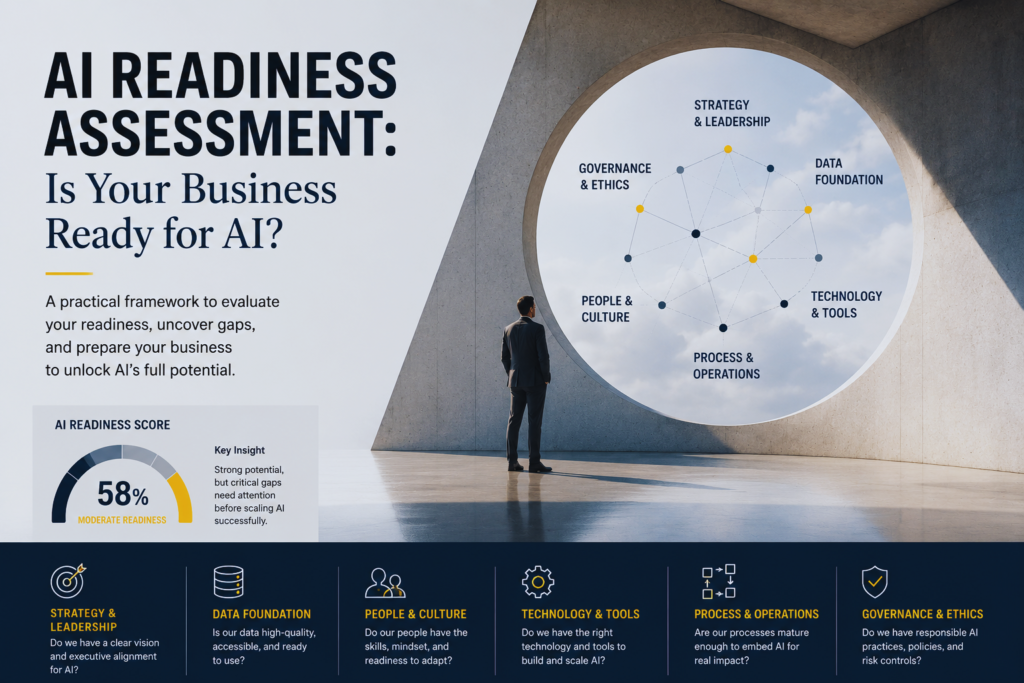
You don’t need “more AI.” You need fewer bottlenecks, faster turnaround times, and less manual work in the workflows that slow your team down. An AI Readiness Assessment helps you determine whether your business can adopt AI successfully—and, just as important, which workflow is ready first—before you spend money on tools that don’t get used.
Most AI projects fail for predictable reasons: unclear outcomes, messy data, missing governance, weak integrations, or a team that isn’t supported through change. A readiness assessment is how you spot those risks early and turn AI interest into an implementation plan.
Quick Answer (40–60 words): An AI Readiness Assessment is a structured way to evaluate whether your business has the strategy, data access, governance, infrastructure, and skills to implement AI safely and profitably. For small businesses, the best approach is use-case specific: pick one workflow, score readiness, close the biggest gaps, then pilot with measurable KPIs.
What is an AI Readiness Assessment (and what it isn’t)?
An AI readiness assessment is a multi-dimensional review of your ability to select, deploy, and sustain AI in day-to-day operations. It typically evaluates pillars such as strategy, data, governance, infrastructure, and people/culture (many frameworks use 6–7 pillars).
It’s not a vibe check. And it’s not the same as buying an “AI platform.” A strong assessment produces outputs you can act on:
- A gap map: what’s missing, where, and why it blocks AI
- A prioritized use-case shortlist: what to do first (and what to avoid for now)
- A sequenced roadmap: quick wins + foundational fixes in the right order
- Success metrics: KPIs tied to business outcomes, not “AI maturity” language
AI readiness vs. AI maturity assessment
These terms are often mixed together, but they’re different enough to matter:
- AI readiness asks: “Can we start successfully and safely now for a specific use case?”
- AI maturity assessment asks: “How advanced is our overall AI capability over time?”
Consultant Insight: Maturity models can accidentally delay action—especially in SMBs—because they encourage broad benchmarking before you’ve proven one workflow. Readiness is more practical when it’s tied to a single workflow, a single owner, and a single KPI.
Why AI readiness matters before you buy tools
Most small businesses don’t fail with AI because the model is “not smart enough.” They fail because the business wasn’t ready operationally.
Here’s what readiness protects you from:
- Tool sprawl: buying multiple AI subscriptions that don’t integrate into real workflows
- Failed pilots: experiments that never make it into daily use because no one owns rollout
- Data dead-ends: discovering too late that key information is locked in PDFs, inboxes, or siloed systems
- Compliance and trust risk: unclear rules around privacy, customer data, and human review
- Low adoption: employees quietly ignoring AI because it adds steps instead of removing them
A good readiness assessment also creates upside: it helps you prioritize the few AI use cases that can deliver measurable value fastest—typically time savings, cycle-time reduction, and more consistent customer response.
Business-First AI Framework™: the simplest way to assess readiness
At Intelligent AI Lab, the most reliable way to keep readiness practical is to start with business outcomes, not technology. Use this sequence:
- Business Problem (what’s slowing you down or costing you money?)
- Workflow Improvement (what steps are manual, repetitive, or error-prone?)
- Choose the Right Solution (automation, AI assistant, document AI, etc.)
- Implement with Human Oversight (review, escalation, auditability)
- Measure Business Outcomes (cycle time, hours saved, response time, error rate)
- Standardize and Scale (templates, SOPs, training, governance)
Business-First AI Insight (highlight): The real question is usually not “Are we ready for AI?” It’s “Which workflow is ready first—and what’s the minimum readiness we need to deploy it safely?” Many businesses are ready enough for one narrow, low-risk workflow even if they aren’t ready for AI everywhere.
AI Readiness Assessment Checklist (SMB-friendly)
If you want a fast, practical self-check, use this as your starting AI adoption checklist. Don’t aim for perfection—aim for clarity.
- Outcome: We can name one workflow and one KPI we want to improve.
- Owner: One person owns the pilot end-to-end (not “the team”).
- Data access: The inputs we need are accessible (not trapped in someone’s inbox).
- Data quality: The workflow isn’t powered by inconsistent or constantly changing data definitions.
- Governance: We know what data is allowed, what’s sensitive, and who approves exceptions.
- Human review: We’ve defined what the AI can do automatically vs. what must be reviewed.
- Integration path: We know how results get into the system of record (CRM, help desk, ERP, shared drive).
- Change plan: The people impacted know what changes and why it helps them.
- Measurement: We can measure before/after with a simple baseline.
- Iteration: We can run a 2–4 week pilot cycle and adjust quickly.
If you answered “no” to multiple items, you’re not blocked—you’ve just identified the real work required before AI can deliver ROI.
The 6–7 pillars of AI readiness (what to assess and why)
Most established frameworks converge on a core set of pillars. Some use six pillars (strategy, infrastructure, data, governance, talent, culture). Others expand to seven by separating items like model management or experience/AI strategy. For small businesses, the goal is not to mirror enterprise structure—it’s to ensure you’re not ignoring a pillar that will break implementation.
1) Strategy & business value clarity
Why it matters: AI can save time, but only if it’s attached to a measurable outcome. Without a clear target, you’ll end up with demos and experiments that don’t stick.
Use it when: you can name a workflow problem (cycle time, backlog, admin load, lead response) and a KPI.
Don’t use AI when: the real issue is unclear ownership, broken handoffs, or missing SOPs. Fix the workflow first—then add AI where it removes friction.
Implementation consideration: define “done” in business terms: a weekly report that takes 3 hours becomes 30 minutes; first-response time drops; invoice processing cycle shortens.
2) Data foundations (access, quality, ownership)
Why it matters: Even “simple” AI workflows rely on inputs—customer history, ticket context, product info, policy documents, invoices, or meeting notes. If your data is fragmented or unreliable, the AI output will be inconsistent.
- Access: Can the AI workflow reach the needed documents/systems?
- Quality: Are fields complete and consistent (names, SKUs, statuses, categories)?
- Ownership: Who is responsible for data definitions and cleanup?
- Suitability: Is the data appropriate for the intended use case?
Trade-off: Data cleanup can feel like “overhead,” but it’s often the difference between a pilot that works for one person and a workflow that works for the business.
3) Governance, privacy, and security
Why it matters: The risk isn’t only external breach—it’s internal misuse, accidental sharing of customer data, unclear retention rules, and a lack of human oversight for decisions that require judgment.
Minimum governance for SMBs:
- Define what data is allowed in AI tools (and what is prohibited)
- Set review rules (what must be approved by a human)
- Establish escalation (who handles exceptions and edge cases)
- Document acceptable use for employees
When you should not automate: high-stakes decisions (credit, eligibility, medical advice, legal conclusions) without proper controls and professional review. Many businesses can start with AI assistance (drafting, summarizing, classifying) long before AI decisions.
4) Infrastructure & integration readiness
Why it matters: The best AI output is worthless if it can’t land where work happens. Most ROI comes from integrating AI into existing systems rather than asking staff to copy/paste between tools.
Assess:
- System of record: where the final data must live (CRM, help desk, ERP, shared drive)
- Integration options: APIs, built-in connectors, or automation platforms
- Identity & access: who can access what, and how permissions are managed
- Reliability needs: what happens if the AI workflow fails for a day?
Common mistake: building a pilot that works in a standalone AI chat window, then realizing later it needs integration work to become “real.” Whenever possible, design the pilot around the system where the workflow already lives.
5) Talent, AI literacy, and workflow redesign skills
Why it matters: Your team doesn’t need to become machine learning engineers. They do need enough AI literacy to use tools safely, validate outputs, and redesign workflows to take advantage of AI assistance.
Look for:
- basic prompt and review skills
- comfort with structured templates (intake forms, categorization, checklists)
- ability to spot errors and escalate
- capacity to run a pilot without disrupting operations
Trade-off: training takes time, but skipping it usually costs more through rework and low adoption.
6) Culture, adoption, and change management
Why it matters: Even a technically perfect automation fails if employees don’t trust it, don’t understand what’s changing, or feel threatened by it.
Practical adoption indicators:
- leaders communicate “why” in business terms (time back, fewer errors, better service)
- people can give feedback without being labeled “anti-AI”
- there’s clarity on how performance is measured after the change
Consultant Insight: The fastest way to kill adoption is to roll out AI as a mandate without fixing the workflow friction that staff already hate. If the workflow is painful today, redesign it first—then use AI to remove the remaining repetition.
Optional 7) Model management (mostly for advanced teams)
Some frameworks separate “model management” (monitoring, versioning, evaluation, drift, auditability). Most SMBs don’t need a formal model management program for early pilots—because they’re starting with narrow, low-risk workflows and human oversight.
You do need model management concepts earlier if you’re:
- automating decisions with significant customer impact
- running multiple AI workflows across departments
- building custom AI systems rather than using packaged tools
AI Readiness Scorecard: how to score your business (without overcomplicating it)
A readiness score is only useful if it changes what you do next. For SMBs, a simple 0–3 scale per pillar is often enough to identify your first safe pilot and your biggest blockers.
| Pillar | Score 0 | Score 1 | Score 2 | Score 3 |
|---|---|---|---|---|
| Strategy | No clear use case | Idea list, no KPI | 1 workflow + KPI defined | 1 workflow + KPI + owner + baseline |
| Data | Unknown sources | Data exists but messy/siloed | Accessible, partial cleanup | Accessible, owned, consistent definitions |
| Governance | No rules | Informal “be careful” | Basic policy + review/escalation | Documented controls + audit trail for pilot |
| Infrastructure | No integration path | Manual copy/paste | Some connectors/APIs | Clear integration into system of record |
| Talent | No capacity | One champion only | Small pilot team trained | Pilot team + documentation + support plan |
| Culture | High resistance | Confusion/fear | Willing to try with guardrails | Feedback loop + adoption tracked |
How to interpret your score:
- Mostly 0–1: don’t buy a big platform. Start by choosing one workflow and fixing access/governance basics.
- Mostly 2: you’re ready for a narrow pilot integrated into an existing workflow with human review.
- Mostly 3: you’re ready to scale to additional workflows and introduce standardization (templates, SOPs, governance expansion).
Decision tree: should you start AI now, or fix the workflow first?
Use this quick decision tree to avoid “AI theater” (activity without operational change):
- Can you name one business problem with a measurable KPI?
- If no: define the outcome first.
- Is the workflow stable enough to map in 30 minutes?
- If no: simplify and standardize the workflow before adding AI.
- Do you have access to the inputs (documents, tickets, CRM records) required?
- If no: fix data access and ownership first.
- Can you implement basic privacy/security rules and human review?
- If no: draft a minimum governance policy before piloting.
- Can you run a 2–4 week pilot with an owner and a feedback loop?
- If yes: start the pilot now.
- If no: solve resourcing and ownership first—then pilot.
Common gaps that block AI adoption (and what they look like in real operations)
These are the gaps that repeatedly show up across readiness frameworks—and they’re especially common in small businesses where systems evolved organically.
Gap 1: “We want AI” but can’t define success
Why it happens: leadership hears compelling AI stories but hasn’t translated them into workflows and KPIs.
Consequence: pilots drift into experimentation and never become standard work.
Better approach: pick one KPI: response time, cycle time, hours spent, error rate, backlog size, or conversion speed.
Gap 2: Data exists, but no one owns it
Why it happens: spreadsheets, inboxes, shared drives, and multiple apps create “shadow systems.”
Consequence: AI outputs vary and trust collapses: “It’s wrong half the time.”
Better approach: assign a data owner for the pilot scope and define one source of truth.
Gap 3: Governance arrives after the pilot
Why it happens: governance sounds “enterprise,” so SMBs postpone it.
Consequence: sensitive data is exposed, staff use AI inconsistently, and the pilot gets paused.
Better approach: define minimum controls early: allowed data, review rules, escalation path.
Gap 4: Standalone AI usage instead of workflow integration
Why it happens: chat-based AI is easy to try, so teams start there.
Consequence: value stays personal, not operational. People copy/paste and results aren’t tracked.
Better approach: design the pilot where work already happens (CRM/help desk/docs) and ensure outputs land in the system of record.
Gap 5: Adoption is assumed, not managed
Why it happens: leadership assumes “people will use it because it’s helpful.”
Consequence: usage fades after week two, and the project is labeled a failure.
Better approach: track adoption (who uses it, how often), collect feedback weekly, and tighten the workflow.
From readiness to results: a practical 30-day readiness-to-pilot plan
The best assessments don’t end with a score. They end with momentum and a clear, low-risk next step.
Week 1: Choose one workflow and baseline it
- Select one workflow with visible pain (admin load, support backlog, lead follow-up delays).
- Write the workflow in 7–10 steps (simple is fine).
- Pick one KPI and measure current baseline for 1 week.
- Name a pilot owner and define stakeholders.
Week 2: Close the minimum readiness gaps
- Confirm data access for the workflow inputs.
- Define governance: allowed data, prohibited data, human review points.
- Decide where outputs must land (system of record).
- Create templates (intake forms, response formats, categorization rules).
Week 3: Run the pilot with human oversight
- Start narrow: one team, one queue, or one workflow stage.
- Require human review where risk is high (customer-facing claims, financial decisions).
- Capture exceptions: when AI fails, why, and what should happen next time.
Week 4: Measure, standardize, decide scale
- Compare KPI to baseline (cycle time, hours spent, response time, error rate).
- Decide: scale, revise, or stop.
- Document the new SOP and training notes.
- Only then add the next workflow.
Best first AI use cases (by business function) based on readiness reality
For small businesses, the best first use cases are narrow, measurable, and low-risk—often AI-assisted rather than fully automated.
| Business Function | Good First Use Case | Why It’s a Smart Start | Main Risk to Control |
|---|---|---|---|
| Operations | Meeting summarization + action tracking | Clear input/output, easy baseline, low integration needs | Accuracy of tasks; require review before assignment |
| Customer Support | Ticket triage + suggested replies | Reduces handling time without removing human agent | Tone/accuracy; add approval step |
| Sales Ops | Lead qualification notes + follow-up drafts | Faster response and consistency | Hallucinated details; restrict to CRM fields and templates |
| Finance/Admin | Invoice/document extraction + validation | High manual effort, clear fields, measurable cycle-time impact | Extraction errors; require validation rules and spot checks |
| Marketing | Content repurposing from one source asset | Low-risk, quick time-to-value | Brand and claims; require review and style guidelines |
| All teams | Internal knowledge search (policies, SOPs) | Reduces time searching and repeat questions | Outdated info; ensure document ownership and update cadence |
Tools and templates: what to use (and how to choose)
You don’t need a complex platform to run a useful business AI readiness review. The right “tool” depends on your company size and how formal the output must be.
| Option | Best For | Ease of Use | Time to Value | Business Size | Notes |
|---|---|---|---|---|---|
| SMB checklist approach | First AI pilot planning | High | Fast (days) | Small business | Most practical when tied to one workflow and one KPI; more “do this next” than “benchmark.” |
| Vendor readiness wizards (ecosystem-based) | Organizations planning within a specific stack | Medium | Medium | SMB to mid-market | Often structured around pillars like strategy, governance, data, infrastructure; validate current details in official vendor documentation. |
| Survey templates (stakeholder pulse checks) | Getting input from staff and managers | High | Fast | Any | Only as good as your questions and scoring; useful for adoption/culture readiness. |
| Enterprise diagnostic assessments | Board-level transformation planning | Low to Medium | Slower (weeks) | Mid-market to enterprise | Typically produces scores and roadmaps; can be too heavy for a first SMB pilot. |
Expert Verdict: Most small businesses should start with an SMB-style, use-case-specific readiness assessment (one workflow, one KPI, one owner) rather than an enterprise maturity diagnostic. Enterprise frameworks become valuable when you’re coordinating multiple departments, larger budgets, heavier compliance needs, or significant integration and governance complexity.
How to improve AI readiness (without turning it into a six-month project)
Improving AI readiness is usually about removing friction from the workflow and putting basic guardrails in place. Focus on the smallest set of changes that make a pilot safe and measurable.
Start Today (low effort, high clarity)
- Pick one workflow and write the KPI you want to move.
- Baseline the KPI for one week.
- Create a one-page “allowed vs prohibited data” rule for AI usage.
Improve Next (next 30 days)
- Clean up the minimum data fields needed for the pilot (not the whole database).
- Define escalation: who reviews exceptions and how fast.
- Integrate outputs into the system of record where possible.
- Train a small pilot group on review and error spotting.
Scale Later (after you’ve proven one workflow)
- Standardize templates, SOPs, and a repeatable pilot process.
- Expand governance beyond the pilot (retention, auditability, access controls).
- Create a use-case intake process and prioritization model.
- Reassess readiness periodically as workflows, tools, and regulations evolve.
FAQ: AI Readiness Assessment
What is an AI readiness assessment?
An AI readiness assessment is a structured evaluation of whether a business has the strategy, data foundations, governance, infrastructure, and people capability needed to adopt AI successfully and sustain it in real workflows.
How do you measure AI readiness in a small business?
The most practical method is use-case specific: choose one workflow, define one KPI, then score readiness across strategy, data, governance, integration, and adoption. If you can’t integrate AI output into the workflow or measure improvement, you’re not ready for that use case yet.
What are the pillars of AI readiness?
Most frameworks include strategy, data, governance (privacy/security), infrastructure/integration, talent, and culture/adoption. Some add a separate pillar for model management when AI systems become more complex or higher risk.
Is AI readiness the same as an AI maturity assessment?
No. AI readiness focuses on whether you can start successfully now (often for a specific workflow). AI maturity describes how advanced your organization’s AI capability is over time and is typically used for broader benchmarking and transformation planning.
Should we buy AI tools before doing an AI readiness assessment?
In most cases, no. Start with the business problem and workflow first. Then assess whether you have the data access, governance, and integration path to make the tool useful in daily operations. Otherwise, you risk paying for software that becomes a standalone experiment.
What is the biggest blocker to AI adoption?
Across many readiness frameworks, the most common blockers are unclear business value (no KPI), poor data foundations (siloed or low quality), and weak governance (privacy/security and oversight defined too late).
How often should we repeat an AI readiness assessment?
Repeat it periodically or whenever you expand to a new department or higher-risk use case. Readiness changes as your tools, data, workflows, and regulatory expectations evolve.
What happens after an AI readiness assessment?
The best next step is a prioritized roadmap: quick wins you can pilot safely, the minimum gaps to close first (data, governance, integration), and success metrics. The assessment should directly inform a 30–90 day implementation plan.
Conclusion: the best AI readiness question is “Which workflow is ready first?”
An AI Readiness Assessment isn’t about proving you’re “advanced enough” to use modern technology. It’s about protecting your time and budget by choosing the right first workflow, putting minimum guardrails in place, and measuring outcomes that matter.
If you take one idea from this guide, make it this: you don’t need to be enterprise-ready to get value from AI—but you do need to be workflow-ready. Start with one workflow, one KPI, one owner, and one integration path. Prove value. Then scale with confidence.
Next steps: Pick a workflow that’s repetitive and measurable, complete the scorecard, and build a 30-day pilot plan with human oversight. If you want a second set of eyes, consider a structured readiness-to-roadmap session so your assessment turns into an implementation asset—not a document that sits in a folder.