AI ROI Case Study: Measuring Business Value from Automation
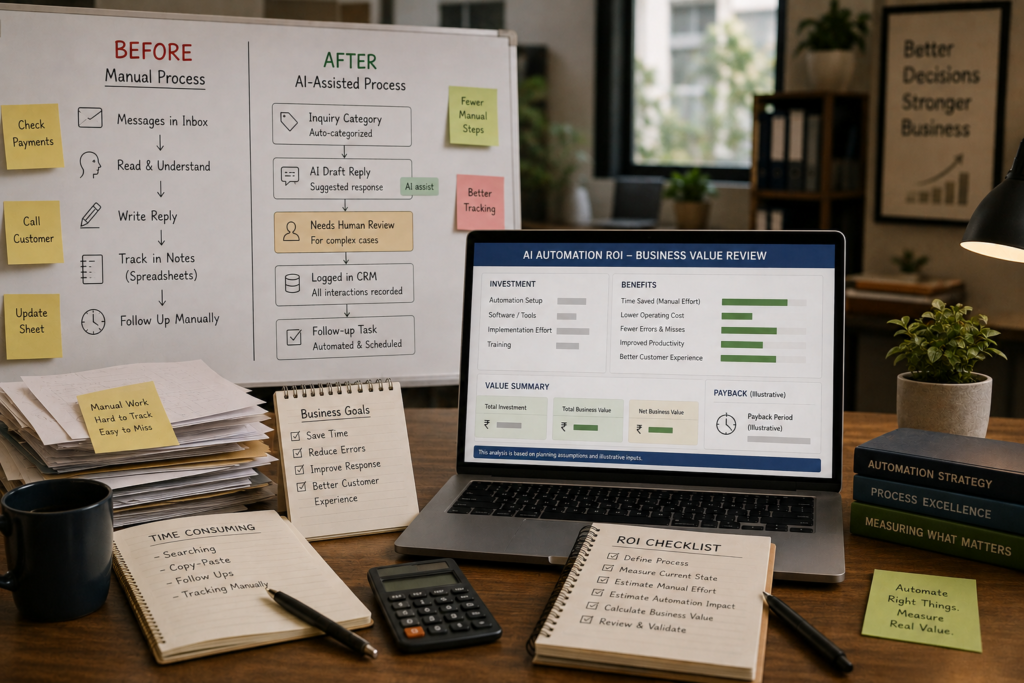
An AI automation project can save 40 hours a month and still lose money.
That’s the uncomfortable truth many small businesses discover after implementing an AI automation project. Saving employee time does not automatically mean the business is saving money.
The real question is whether the time saved becomes measurable business value after software costs, implementation, human review, maintenance, and other ongoing expenses.
Case Study Metadata
| Field | Details |
|---|---|
| Case Study Type | Illustrative SMB ROI Case Study (India-focused) |
| Evidence Type | Planning model + worked example; not a verified single-company implementation |
| Industry | Multiple industries using common SMB customer-operations and back-office workflows |
| Business Type | Small business / SMB |
| Primary Workflow | Baseline measurement → automation pilot → time savings + quality tracking → TCO + ROI analysis |
| Primary Keyword | AI Automation ROI |
| Automation Risk | Low to Moderate; higher when automation is customer-facing or actions are irreversible |
| Implementation Difficulty | Beginner to Intermediate; measurement is easier than reliable attribution |
| Primary Objective | Determine whether automation creates measurable business value, not merely tool adoption |
Important scope: This is an illustrative SMB ROI case study designed to show how a small business can evaluate the business value of AI-assisted automation. It is not a documented implementation for a specific company and does not claim verified business results. Any costs, time savings, percentages, or ROI figures in this article are hypothetical planning assumptions unless explicitly identified otherwise. Real results depend on workflow volume, process quality, implementation, adoption, data quality, human review, and the tools used.
Case Study Snapshot: What “AI Automation ROI” Really Means
Many small businesses buy an AI or automation tool because it promises to “save time.” Then comes the harder question: Did it actually create financial value?
In practice, AI Automation ROI is not a single number that comes from the tool. It is a measurement discipline that connects four things:
- Baseline work — time, volume, errors, delays, rework, missed follow-ups, and other measurable operating conditions.
- What changed — steps removed, steps accelerated, response times improved, quality changed, or capacity was freed.
- Total cost of ownership (TCO) — subscriptions plus implementation, integration, training, monitoring, maintenance, and human review.
- Value realized — cost actually removed, capacity actually used, risk reduced, or measurable customer/revenue outcomes.
This case study is intentionally business-first. It starts with the operational problem, defines a measurable workflow, and then shows how an SMB can evaluate AI ROI using simple logs, a spreadsheet model, and a focused KPI set.
The key principle is simple: measure the workflow before buying or scaling the technology.
Business Context & Workflow: Where ROI Measurement Usually Breaks
Consider a typical Indian SMB with roughly 10–50 employees operating in a service, retail, education, or B2B support context. The business may handle:
- Leads and customer queries through email, website forms, WhatsApp, Instagram, or marketplace messages.
- Internal task handoffs through spreadsheets and chat.
- A CRM, helpdesk, or shared spreadsheet as a partial system of record.
- Manual daily or weekly reporting for the owner or operations manager.
The workflow selected for ROI measurement should have two characteristics:
- Repeatability — the same kind of request happens frequently.
- Measurability — volume, time, quality, and outcomes can be counted or timestamped.
For this illustrative scenario, the business selects one narrow pilot workflow: Customer inquiry handling + follow-up logging.
| Workflow Element | Illustrative Definition |
|---|---|
| Input | Inbound inquiries from messages, forms, or email |
| Output | Response sent + inquiry logged + next action assigned |
| System of record | CRM, helpdesk, or shared spreadsheet |
| Workflow owner | Operations manager, with sales/support team execution |
This workflow matters because delays and inconsistency can affect customer experience and potentially conversion, while staff spend time on repetitive interpretation, data entry, response drafting, and follow-up.
The Problem & Business Impact: Why “Time Saved” Isn’t Enough
The owner’s real problem is not necessarily “we need AI.” The problem may be that the business cannot confidently determine whether automation created value because measurement is weak or missing.
- No baseline: after launch, nobody knows the prior time-per-task or error rate, so improvement becomes a feeling rather than evidence.
- Tool adoption replaces outcome measurement: teams track messages handled by AI instead of response time, completion, rework, or business outcomes.
- TCO is incomplete: the subscription is counted, but setup, integration, manager review, training, maintenance, and monitoring are ignored.
- Revenue attribution is overstated: sales improve after launch, but other factors such as seasonality, pricing, promotions, staffing, or marketing may be responsible.
This makes ROI discussions unstable. Supporters cannot prove value, while skeptics can dismiss the project as another software expense.
A business-first ROI approach solves this by defining what will be measured, how it will be measured, and for how long before the automation is expanded.
Decision gate: this workflow is a suitable pilot candidate when inquiry volume is reasonably steady, the steps are repeatable, and the business can capture reliable timestamps and outcomes. It is a weak candidate when volume is very low, requests are highly bespoke, or baseline measurement is unreliable.
Before: The Manual Workflow
Inquiry arrives → Staff reads message → Staff identifies intent → Staff checks context in CRM/sheet → Staff drafts response → Staff sends response → Staff logs inquiry + tags status → Staff sets follow-up reminder
The process may work, but it depends heavily on individual employees reading, interpreting, recording, and remembering what to do next.
Baseline Measurement: What to Measure Before Changing Anything
If you want to measure AI Automation ROI, you need baseline data. For a small business, a lightweight work log over 2–4 weeks—or until a representative sample has been collected—is often sufficient for an initial pilot.
- Volume — inquiries per day, week, and month.
- Handling time — minutes spent per inquiry, measured using a representative sample.
- First response time — time from inquiry arrival to first reply.
- Completion rate — percentage of inquiries receiving the required response and next action.
- Rework rate — percentage requiring correction, escalation, or additional work because of mistakes or missing information.
- Missed follow-up rate — percentage of required follow-ups that become overdue or are missed.
- Human review time — minutes spent reviewing, correcting, or approving automation outputs after launch.
Baseline discipline matters. Every post-automation improvement you later claim needs a comparable baseline and measurement window.
Illustrative Baseline: Planning Assumptions
The following values are hypothetical planning inputs for an India-based SMB. They are not measured company data and should be replaced with the business’s own baseline before using them for a real investment decision.
| Baseline Metric (Manual) | Illustrative Value | How to Measure |
|---|---|---|
| Monthly inquiry volume | 1,000 inquiries/month | Count messages, tickets, or leads |
| Average handling time | 6 minutes/inquiry | Time sample of 30–50 representative inquiries, then average |
| First response time (median) | 2 hours | Received timestamp → first reply timestamp |
| Rework/escalation rate | 8% | Count cases requiring correction or supervisor help |
| Missed follow-up rate | Illustrative baseline to be measured | Count overdue or missed required follow-ups |
| Staff involved | 2 frontline staff + 1 supervisor for exceptions | Track who touches each inquiry |
AI Automation Design: What Gets Automated vs. What Stays Controlled
The business-first sequence is:
Improve the workflow → Standardize the rules → Automate predictable steps → Use AI where unstructured language requires it → Measure the result
The goal is not to put AI everywhere. The goal is to use the simplest technology that produces measurable value.
Workflow Improvement Before Adding AI
- Standardize inquiry categories: sales, support, pricing, refund/return, appointment, complaint, and other.
- Create approved response templates for common questions.
- Define “done” criteria: what a complete response must contain, such as price, availability, next step, contact details, or policy link.
- Define escalation rules for refunds, legal threats, sensitive complaints, high-value opportunities, pricing exceptions, and ambiguous cases.
- Define the system of record so that every inquiry has one authoritative status and owner.
These changes can reduce variability even before AI is introduced. They also make the later automation safer and easier to measure.
Proposed AI Automation: A Narrow, Measurable Role for AI
This describes a recommended pilot architecture, not a verified implementation for a specific business.
Trigger: An inquiry arrives through an inbox, helpdesk, WhatsApp channel, or web form.
AI tasks may include:
- Classification — categorize inquiry type and urgency.
- Extraction — capture relevant fields such as customer name if provided, product/service, location, preferred time, or order number.
- Drafting — generate a suggested response using approved templates and business rules.
- Summarization — create a concise internal note for logging and follow-up.
Business rules remain non-negotiable:
- Do not promise discounts, refunds, delivery dates, or other commitments beyond approved policy.
- Do not ask for or store unnecessary sensitive personal data.
- Escalate complaints, legal threats, high-value deals, ambiguous pricing, and other defined risk categories.
- Log automation actions for auditability: what was suggested, what was sent, whether a human edited it, and whether escalation occurred.
System actions may include:
- Create or update the record in the system of record.
- Assign an owner based on business rules.
- Send a response only when the category is approved for automated sending; otherwise keep it as a draft.
- Set a follow-up task or reminder.
Human approval is recommended for a conservative pilot. Staff can review defined high-risk categories and low-confidence cases.
Fallback: if the inquiry is ambiguous, missing required information, or cannot be matched to an approved workflow, route it to a human with a suggested clarification question.
Monitoring should record category, confidence or review status, response time, human edits, escalation, and outcome.
Why AI—and Where Simpler Automation May Be Enough
Some parts of the workflow do not need generative AI:
- Routing messages by known channel or category.
- Sending standard acknowledgements.
- Creating CRM records from structured forms.
- Setting follow-up reminders based on dates or status.
- Generating scheduled reports from structured data.
AI becomes proportionate when the input is unstructured and requires language understanding—for example, interpreting a messy natural-language inquiry, extracting relevant details, classifying intent, or drafting a response.
After: Automated Workflow
Inquiry arrives → AI classifies + extracts key details → Rules validate allowed actions → Draft reply + internal summary created → Human review for exceptions/low confidence → Approved response sent → Auto-log + follow-up task created → Escalations handled by supervisor
Before vs. After: Step-Level Comparison
| Workflow Element | Before (Manual) | After (Proposed Automation) |
|---|---|---|
| Read + interpret inquiry | Manual for every inquiry | AI assists through classification/extraction; exceptions go to humans |
| Draft response | Manual typing; variable quality | AI drafts from approved content; human edits where required |
| Logging | Often delayed or skipped | Automated standardized record creation/update |
| Follow-up reminders | Manual and dependent on memory | Automated tasks based on status/category/SLA rules |
| Measurement readiness | Data may be missing or inconsistent | Consistent timestamps, tags, and audit logs |
| Human role | Repetitive execution | Judgment, approvals, exceptions, QA, and workflow improvement |
What the AI Does Not Do
- It does not approve refunds, discounts, or contractual commitments.
- It does not resolve payment disputes automatically.
- It does not make irreversible business decisions without appropriate human controls.
- It does not override business rules.
- It does not rely on general internet knowledge for business-specific policies.
- It does not invent information that is not available in approved business sources.
- It does not continue interacting with a customer when the workflow requires human intervention.
- It does not access unnecessary sensitive information.
A good automation system knows when not to act. When uncertain, it should ask for clarification or escalate to a human.
Human Control, Risks & Safeguards
Automation does not remove accountability. ROI measurement can also fail when human time simply moves into hidden review and exception work. Human review time must therefore be measured as part of the after-state.
Where Humans Remain Responsible
- Business and policy ownership
- Approval and exception handling
- Sensitive customer situations
- Quality control and sampling
- Knowledge-base and template accuracy
- Workflow ownership
- Review of automation failures
- ROI governance and measurement consistency
Risk-to-Safeguard Mapping
| Risk | What Could Go Wrong | Safeguard |
|---|---|---|
| Incorrect interpretation | Wrong category, response, or routing | Confidence/exception thresholds and human review; measure override rate |
| Hallucinated or non-policy claims | AI invents prices, refund terms, or delivery promises | Approved templates/knowledge sources and policy rules |
| Privacy leakage | Unnecessary customer information is shared | Minimum necessary data, permissions, retention controls |
| Integration failure | CRM not updated, message not sent, duplicate created | Retries, alerts, and reconciliation |
| Hidden human workload | Review time consumes expected savings | Track review minutes per item and override/edit rate |
| Over-automation | Customer cannot reach a person | Clear escalation path and defined human ownership |
| Accountability gap | Nobody owns outcomes | Named workflow owner and audit trail |
| Silent failure | Automation fails without notice | Monitoring, alerts, and periodic reconciliation |
Technology Architecture
There is no single technology stack that every small business should use. The technology should follow the workflow and measurement requirements.
| Component | Purpose |
|---|---|
| Email / WhatsApp / Web Form / Helpdesk | Receives inquiries and sends approved responses |
| CRM / Helpdesk / Spreadsheet / Database | System of record for status, ownership, timestamps, and outcomes |
| Automation / Orchestration Platform | Connects systems, triggers workflows, routes items, and logs events |
| AI Model / API | Classification, extraction, drafting, and summarization within defined boundaries |
| Knowledge Base | Stores approved business information and response content |
| Human Review Queue | Handles exceptions, approvals, and QA |
| Measurement Layer | Tracks baseline, KPIs, TCO, and ROI |
A business should not begin with “Which AI tool should I buy?” A better starting question is: “Which workflow is consuming the most repetitive effort, and why?”
Implementation Difficulty
- Beginner: baseline measurement with a spreadsheet, template standardization, basic routing, and logging.
- Intermediate: reliable integrations, audit logging, safe boundaries, monitoring, and consistent KPI reporting.
- More complex: multiple systems, customer-facing autonomous actions, sensitive data, high transaction volumes, or workflows requiring complex exception handling.
The technical part is often not the hardest part. Operational discipline—collecting baseline data, keeping categories stable, measuring human review time, and assigning ownership—is often more important to reliable ROI measurement.
Cost of AI Automation: Use a TCO View
There is no single typical cost for AI automation. Total cost depends on workflow volume, number of integrations, AI usage, automation platform, business software, implementation approach, human review, and maintenance.
A useful TCO model includes:
| Cost Category | What It Includes | How It Appears in ROI |
|---|---|---|
| Software subscriptions | Automation platform, AI usage, CRM/helpdesk/messaging costs | Recurring monthly/annual cost |
| One-time implementation | Setup, integration, workflow design, testing | Upfront investment |
| Training & change management | Staff training, SOP updates, adoption support | Upfront and periodic cost |
| Human review & operations | Approvals, exception handling, QA sampling | Ongoing cost that reduces net savings |
| Maintenance | Template/rule updates, integration fixes, workflow tuning | Ongoing cost |
| Monitoring & governance | Logging, alerts, access controls, vendor review | Ongoing or periodic cost |
The cheapest automation is not necessarily the best automation. A workflow that fails silently can cost more than its software subscription.
Results & Evidence
This article does not present verified results from a specific company.
Verified Results
No verified single-company results are presented in this illustrative case study. The purpose is to show a transparent, CFO-friendly measurement method and ROI model.
Planning Assumptions
The worked example below uses hypothetical inputs. These numbers are not predicted results and should be replaced with actual baseline and post-implementation measurements.
Illustrative ROI Planning Model
A business can estimate potential value using its own baseline data. The core calculation should distinguish gross time savings from value actually realized.
Monthly gross hours saved = Monthly transactions × (Manual minutes − Post-automation minutes) ÷ 60
Gross time value = Monthly gross hours saved × Fully loaded hourly cost
Realized time value = Gross time value × Time Monetization Factor
Monthly net benefit = Realized time value + Other validated monthly benefits − Recurring automation costs
Payback period = One-time implementation cost ÷ Monthly net benefit, but only when monthly net benefit is positive. If monthly net benefit is zero or negative, a payback period should not be claimed from that model.
Illustrative Scenario: Worked Example in Rupees
The following figures are hypothetical planning assumptions for demonstration only.
| ROI Input | Illustrative Assumption | Purpose |
|---|---|---|
| Monthly inquiries | 1,000 | Replace with measured volume |
| Manual handling time | 6 minutes/inquiry | Baseline average |
| Post-automation handling time | 3.5 minutes/inquiry | Includes human review for applicable cases |
| Time saved | 2.5 minutes/inquiry | Before minus after |
| Loaded employee cost | ₹350/hour | Illustrative salary + applicable overhead |
| Time monetization factor | 60% | Only count time that becomes real business value |
| Monthly software/usage cost | ₹12,000 | Illustrative |
| Monthly maintenance + QA | ₹5,000 | Illustrative |
| One-time implementation | ₹60,000 | Illustrative |
Step-by-Step Calculation
1) Monthly gross hours saved: 1,000 × 2.5 ÷ 60 = 41.7 hours/month.
2) Gross time value: 41.7 × ₹350 = ₹14,595/month.
3) Realized value: ₹14,595 × 60% = ₹8,757/month.
4) Monthly operating cost: ₹12,000 + ₹5,000 = ₹17,000/month.
5) Monthly net benefit from time savings alone: ₹8,757 − ₹17,000 = −₹8,243/month.
6) Payback period: not applicable under these assumptions because the monthly net benefit is negative.
This is a useful result rather than an embarrassing one. A credible ROI model must be allowed to say “do not proceed” or “redesign the business case.”
What This Tells the Business
Under the assumptions above, the automation does not pay for itself from time savings alone. The business should therefore examine the economics before scaling.
- Increase volume within the same workflow without proportionally increasing fixed automation costs.
- Reduce software, AI-usage, or maintenance costs.
- Increase time saved through better templates, routing, and workflow design.
- Reduce unnecessary human review while preserving quality and safety.
- Convert freed capacity into measurable business activity.
- Add other benefits only when they can be measured and are not double-counted.
This is exactly why ROI measurement should happen before a business commits to broad automation.
Scenario Add-On: Revenue Impact
Revenue impact should be treated separately from labor/time savings because attribution is harder.
For example, faster response time may improve conversion. But the business should not automatically claim that any increase in sales was caused by automation.
- Measure baseline inquiry-to-qualified-lead conversion.
- Measure baseline qualified-lead-to-sale conversion.
- Measure the same metrics after implementation over a comparable window.
- Control for major changes such as marketing spend, pricing, promotions, staffing, and seasonality where possible.
- Use contribution margin rather than gross revenue when the financial model requires a profit-based measure.
- Where attribution is unreliable, treat revenue as a monitored KPI rather than an ROI input.
Business-first principle: measure the operational improvement first. Attribute financial impact only when the evidence supports the connection.
Measuring Business Value Beyond Time Savings
| Benefit | How to Validate |
|---|---|
| Reduced repetitive work | Compare employee hours spent on the workflow before and after automation, including review time |
| Fewer errors and rework | Track corrections, duplicate records, failed transactions, and rework before vs. after |
| Fewer missed follow-ups | Compare missed or overdue follow-ups before and after |
| Faster customer response | Compare first-response and resolution-time timestamps |
| Better consistency | Audit responses/actions against approved policies and workflows |
| Improved management visibility | Compare reporting effort, data completeness, and availability of operational information |
| More owner/employee capacity | Track where freed time is actually redeployed |
| Improved customer experience | Track satisfaction, repeat requests, complaints, or resolution outcomes where reliable data exists |
| Financial impact | Measure cost removed, avoided hiring, capacity value, contribution margin, or supported revenue impact against a defined baseline |
Do not automatically convert time savings into financial savings. If automation frees 20 employee hours per month, that does not automatically mean the business saved the equivalent of 20 hours of salary.
Financial value depends on what happens to the capacity. It may reduce overtime, avoid a future hire, allow employees to serve more customers, increase sales activity, improve service, or give the owner more time for business development.
Therefore, define how freed capacity will create measurable value before including it in the ROI calculation.
Research-Based Measurement Guidance
A sound pilot should use a defined baseline and a defined post-launch measurement window. A 30/60/90-day review structure can provide progressively stronger evidence while allowing the business to correct workflow problems early.
The important principle is not a specific number of days. It is comparability: use stable KPI definitions, comparable periods, and consistent measurement methods.
External frameworks and research may provide useful measurement concepts, but external claims should not be presented as expected results for a specific SMB without evidence.
What Should Not Be Automated First?
- Refund approvals and payment disputes.
- Legal or contractual commitments.
- Complex customer complaints or sensitive conversations.
- High-value pricing decisions.
- Irreversible system actions such as issuing credits, deleting records, or closing critical cases without appropriate approval.
- Workflows where business rules are still unclear.
- Workflows where reliable baseline data cannot be captured.
These workflows may eventually benefit from automation, but they generally require stronger controls, testing, and governance.
Recommended Starting Version: Minimum Viable ROI Pilot
A small business can start with a deliberately conservative version.
- Automate inquiry logging, categorization, owner assignment, draft creation, and follow-up task creation.
- Keep high-risk messages in draft or human-approval mode.
- Measure human review time and override/edit rate.
- Use the same KPI definitions before and after automation.
- Log failures and reconcile inputs against outputs.
- Review results at 30, 60, and 90 days before deciding whether to scale.
This approach produces useful evidence even if the economics are negative. It reveals whether the workflow is a good automation candidate and which levers need to change.
Suggested KPIs
| KPI | Why It Matters | How to Measure | Desired Direction |
|---|---|---|---|
| Average handling time per inquiry | Primary driver of labor savings/capacity | Time sample or work log; include review time | Down |
| Median first response time | Customer experience and potential conversion driver | Received timestamp → first reply | Down |
| Human escalation rate | Shows automation limits and staffing needs | Escalated inquiries ÷ total inquiries | Stable/down without harming quality |
| Human override/edit rate | Measures output quality and hidden effort | AI drafts edited ÷ AI drafts reviewed | Down as workflow matures |
| Rework rate | Quality and risk indicator | Corrections/rework ÷ total inquiries | Down |
| Completion rate | Shows whether the workflow reaches the intended outcome | Completed inquiries ÷ total inquiries | Up |
| Automation failure rate | Shows technical reliability | Failed workflow runs ÷ total runs | Down |
30 / 60 / 90-Day Governance
| Timeframe | Focus | Deliverable / Decision |
|---|---|---|
| First 30 days | Validate logging, integration stability, human workload, and quality | Fix template gaps, integration defects, and measurement problems |
| 60 days | Compare baseline vs. current KPIs; examine escalation, override, and rework patterns | Tune rules, review thresholds, and workflow design |
| 90 days | Finalize TCO, time monetization, quality impact, and other validated benefits | Scale, redesign, or stop |
The goal is not to automate the entire company in 90 days. The goal is to establish a repeatable method for identifying, implementing, measuring, and improving automation opportunities.
When to Expand: Standardize and Scale
Expand only when the pilot demonstrates:
- Stable integrations and visible failure handling.
- Acceptable quality with no material increase in rework.
- Human escalation and override rates that are understood and manageable.
- Evidence of business value: cost removed, capacity used, risk reduced, customer outcome improved, or measurable financial impact.
- A clear workflow owner and monitoring process.
- An acceptable TCO relative to the value realized.
If the economics remain negative after realistic measurement and optimization, the correct decision may be to stop, redesign, or choose a different workflow.
Lessons from the ROI Model
- Baseline first: you cannot reliably prove ROI later if you did not measure before the change.
- TCO drives the truth: subscriptions are rarely the full cost.
- Human review is part of the cost: hidden review work can erase expected savings.
- Time saved must be monetized carefully: capacity is valuable only when it is actually converted into business value.
- Keep the pilot narrow: fewer variables improve attribution.
- Separate value types: labor, quality, risk, customer experience, and revenue should be tracked separately to avoid double-counting.
- Use rules where rules are sufficient and AI where language or unstructured information requires it.
- Keep humans responsible for judgment and high-risk decisions.
- Let the model produce a negative answer: not every automation opportunity is economically attractive.
Before vs. After: The Bigger Transformation
The most important change is not technological. It is operational.
Before:
People remember → People search → People copy → People respond → People follow up → People report
After:
System captures → AI interprets → Rules validate → Automation executes → Humans handle exceptions → System records → Management decides
AI becomes part of the business operating workflow rather than another standalone software tool.
Final Takeaway
AI automation can create significant value for a small business—but not because AI magically makes employees more productive.
The value appears when repetitive work that depends on memory, manual entry, and individual effort is converted into a structured, measurable workflow.
The business-first model is:
Identify the workflow → Measure the baseline → Simplify the process → Automate predictable steps → Use AI where language or unstructured information requires it → Keep humans in control of exceptions → Measure the result → Improve and expand
For many Indian SMBs, the practical opportunity is straightforward:
- Respond to leads faster.
- Reduce repetitive data entry.
- Stop missing follow-ups.
- Automate routine reminders.
- Give employees better information.
- Give owners better operational visibility.
- Free people to spend more time on work that requires human judgment.
That is what responsible AI ROI measurement looks like: not proving that AI is good, but determining whether a specific business workflow creates enough measurable value to justify the investment.
A Practical Next Step
If you are considering AI automation for your business, do not start by buying another AI tool.
Start with a workflow audit. List your 10 most repetitive business tasks and record:
- How often each task occurs.
- How many minutes each task takes.
- Who performs it.
- What systems are involved.
- What rules govern it.
- Where errors and rework occur.
- What happens when something goes wrong.
- Whether the result can be measured.
Then select the workflow with the best combination of:
Volume + Repetition + Clear Rules + Business Impact + Manageable Risk
That workflow should become your first automation candidate.
This business-first approach is the foundation of the Business-First AI Assessment™: understand the business problem, assess the workflow, establish the baseline, identify the right automation opportunity, and only then select the technology.
If the business case does not work after a realistic TCO and measurement review, do not automate it simply because AI is available.
The goal is not to automate everything. The goal is to automate the right things.