AI for Real Estate Agencies: Lead Generation & Sales Automation
If your agency is paying for leads (or generating them organically) but agents still say, “I’m slammed,” you likely don’t have a lead problem—you have a lead handling problem. AI for Real Estate can help you respond faster, qualify better, and automate follow-up so your team spends more time in conversations and closings—not copying data into a CRM.
The catch: the agencies that get results don’t start by buying “AI tools.” They start by finding the one workflow bottleneck that’s leaking appointments—usually slow speed-to-lead, inconsistent nurturing, or weak qualification—then they automate that first.
Quick Answer (40–60 words): AI for real estate agencies is most valuable when it improves speed-to-lead and lead qualification, then automates follow-up and CRM updates. Start by fixing one bottleneck (like replacing static forms with conversational qualification), connect it to your CRM and calendar, set a clear human handoff, and measure appointment rate and response time.
What AI for Real Estate Actually Solves (and what it doesn’t)
Most agencies don’t need “more AI.” They need fewer dropped leads and less manual admin.
In real estate sales operations, AI typically helps in three practical ways:
- Faster response to inbound leads via chat/SMS-style engagement and after-hours coverage.
- Better qualification (budget, location, timeline, financing status, seller motivation) before an agent invests time.
- Less CRM admin through automated routing, tasks, follow-up triggers, and cleaner pipeline visibility.
Where AI is not a good fit:
- Replacing trust-building: showings, negotiations, pricing conversations, and sensitive seller situations still need humans.
- Fixing a broken offer: if your service, reputation, or listing presentation is weak, automation won’t rescue conversion.
- Papering over messy data: poor CRM hygiene undermines lead scoring, routing, and reporting.
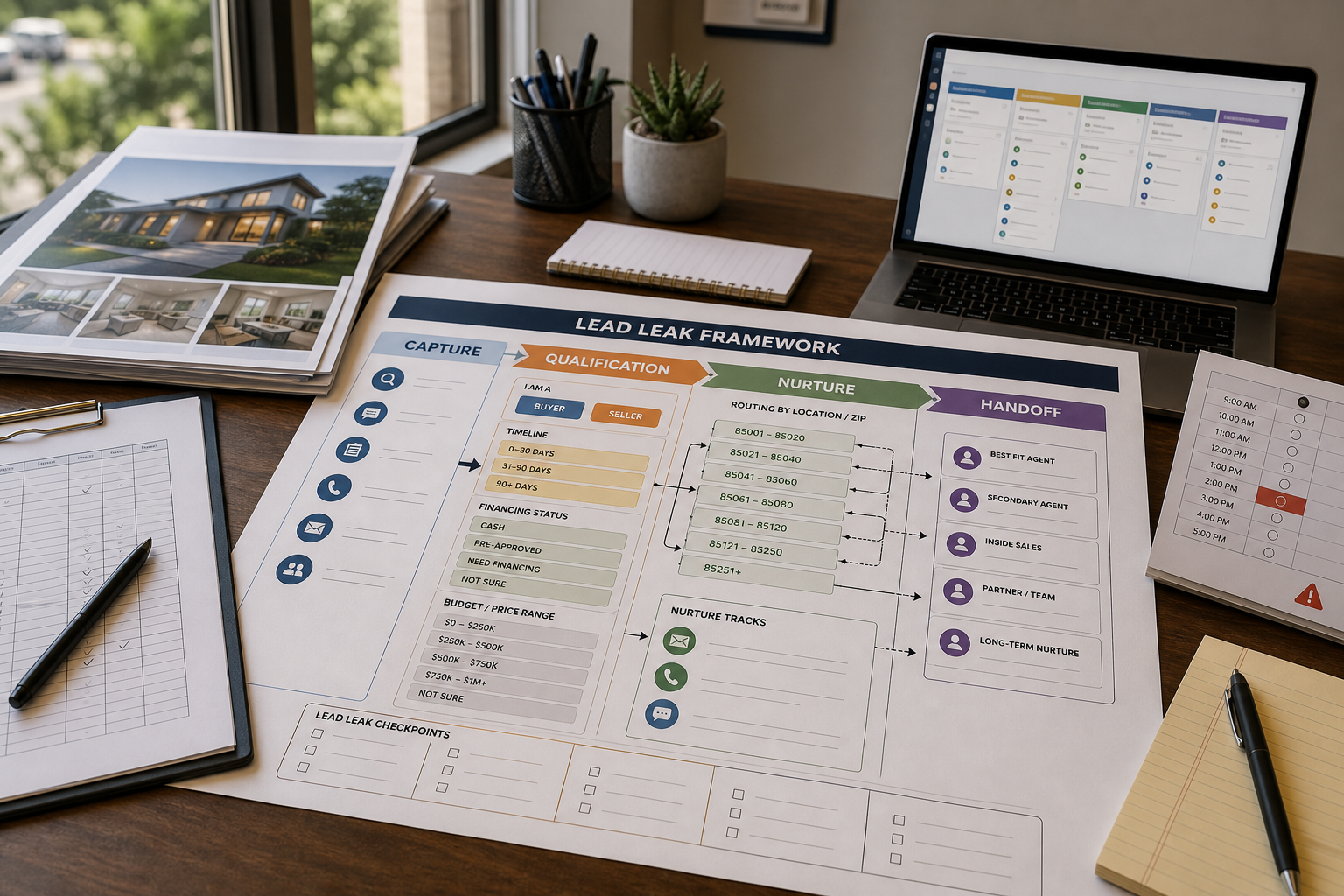
The “Lead Leak Map”: where agencies lose deals before they even start
Before comparing tools, map where revenue leaks out of your pipeline. This is the fastest way to decide whether you need AI lead generation, qualification, or CRM automation.
Use this simple Lead Leak Map to diagnose the problem:
- Traffic leak: not enough inbound demand (ads, SEO, referrals, portals).
- Capture leak: people visit but don’t submit (forms too long, too generic, no quick answers).
- Qualification leak: leads submit but aren’t properly segmented (buyers vs sellers, timeline unknown, budget unknown).
- Nurture leak: leads go cold because follow-up is inconsistent or manual.
- Handoff leak: hot leads don’t get to the right agent fast, or the first human call comes too late.
Consultant Insight: The highest ROI is often not “more leads.” It’s converting the leads you already have more efficiently—especially by upgrading weak forms into conversational qualification and tightening the handoff to an appointment.
Top business pain points AI can fix in real estate sales workflows
These issues show up across agencies, brokers, and teams—especially when multiple channels feed the pipeline (website, portals, paid social, referral partners, open houses, sign calls).
1) Slow response to inbound leads
High-intent prospects often expect fast replies and easy booking. If your first response comes hours later (or the next morning), you’re competing against the agent who replied immediately.
2) Inconsistent follow-up and nurturing
When follow-up lives in individual agent habits, leads fall through the cracks. AI plus CRM automation can enforce consistency without turning your team into robots.
3) Low-quality leads and unclear intent
Static contact forms capture “Name, Email, Message” but miss the intent data that makes a lead actionable: timeline, financing, location, price range, and motivation.
4) Manual CRM updates and messy pipeline visibility
When the CRM isn’t updated, managers can’t forecast, agents can’t prioritize, and reporting becomes guesswork. Automating capture, routing, and task creation reduces admin and improves data completeness.
5) Weak lead prioritization
Without scoring or clear routing rules, agents treat all leads equally. AI-assisted scoring and engagement-based triggers help teams focus attention where it’s most likely to convert.
Best AI use cases by workflow stage (lead-to-close)
A practical way to think about real estate AI is by funnel stage. The “best tool” depends on where your leak is.
| Workflow Stage | Best AI Use Case | Why It Matters | Common Success Metric |
|---|---|---|---|
| Capture | Conversational intake instead of static forms | Captures intent data and reduces friction | Form-to-lead rate, qualified lead rate |
| Qualification | Automated questions + smart routing | Protects agent time and speeds handoff | Lead-to-appointment rate |
| Response | 24/7 chat/SMS-style first response | Stops after-hours lead loss | Speed-to-lead, response rate |
| Nurture | Behavior-triggered follow-up sequences | Consistency over weeks/months | Nurture completion, re-engagement |
| Prioritization | Lead scoring based on intent and engagement | Focuses effort on likely movers | Pipeline velocity, conversion rate |
| Admin / CRM | Auto-log notes, create tasks, update stages | Cleaner CRM, less agent admin | CRM completeness, tasks completed |
| Marketing support | Draft listing descriptions and local content | Increases output without burning agents out | Content cadence, inbound inquiries |
Best tools for lead generation, qualification, and CRM automation (real estate AI)
This section is intentionally business-focused. Feature lists change quickly, and many vendors don’t publish transparent pricing in public sources. The decision you can control is fit: what bottleneck the tool fixes, how hard it is to implement, and whether it integrates cleanly with your CRM, calendar, and messaging stack.
Business impact comparison: which tool category fits your bottleneck?
| Tool | Best For | Ease of Use | Time to Value | Business Size | Notes |
|---|---|---|---|---|---|
| Perspective AI | Conversational lead qualification replacing forms | High | Fast (when you already have traffic) | Small to mid-size agencies | Often high ROI because it captures intent and routes quickly; best when inbound volume exists. |
| Lindy | AI agents for qualification, booking, and CRM updates | Medium | Medium | Solo to small teams | Flexible workflows; requires testing and iteration to get handoffs right. |
| Ylopo | Centralized digital marketing + AI follow-up | Medium | Medium | Teams and brokerages | Real-estate focused lead gen and re-engagement; pricing transparency varies—verify via official sources. |
| CINC AI | Integrated lead-to-close CRM + AI follow-up ecosystem | Medium | Medium | Teams and brokerages | Broad coverage; best when you want a tighter integrated system rather than stitching tools together. |
| SmartZip | Predictive seller prospecting | Medium | Medium | Listing-focused agents/teams | Most valuable after your response and nurture basics are already solid. |
| Offrs | Predictive seller targeting | Medium | Medium | Listing agents | Similar category to SmartZip; integration and pricing details can vary—confirm with vendor documentation. |
| Gupshup | Multi-channel conversational engagement and nurture | Medium | Medium | Teams and brokerages | Strong for messaging-based campaigns; can be more complex to deploy depending on your channel mix. |
| Zoho CRM | CRM backbone + automation | Medium | Medium | Small to mid-size agencies | Flexible CRM automation; less specialized than dedicated real estate CRMs. |
| Wise Agent | Real-estate oriented CRM workflows | High | Fast | Agents and small teams | Real estate CRM positioning; AI depth varies—validate current capabilities before committing. |
| Realvolve | Workflow-driven real estate CRM | Medium | Medium | Agents and teams | Strong workflow approach; confirm current AI/automation features and integrations. |
Expert Verdict: what most agencies should implement first
Expert Verdict: If you already have inbound lead flow, start with conversational lead qualification (for example, replacing static forms with a conversational intake layer) because it improves both speed-to-lead and lead quality at the same time. After that, invest in CRM automation to enforce follow-up consistency. Add predictive seller tools only once capture, qualification, and nurture are already working reliably.
Lead generation AI vs CRM automation: don’t confuse the two
One common purchasing mistake is buying a “lead gen AI tool” when the real issue is CRM follow-through.
- AI lead generation increases or surfaces demand (paid social platforms, predictive seller targeting, re-engagement).
- CRM automation improves conversion (routing, tasks, sequences, lead scoring, and visibility).
If agents aren’t contacting leads quickly or consistently, adding more leads can actually make performance worse (more noise, more missed follow-up, more frustration).
High-ROI workflows you can implement (with realistic examples)
Below are practical workflows aligned to the bottlenecks agencies most often want to fix. Each one includes when to use it, when not to, and what to watch out for during implementation.
Workflow 1: Inbound website lead qualification (replace the static form)
Business problem: Your website gets inquiries, but forms capture weak data and agents waste time chasing unqualified leads.
What changes: A conversational experience asks the few questions that determine next steps (buyer/seller, area, price range, timeline, financing, urgency) and then routes appropriately.
Example scenario: A mid-size agency has a “Contact Us” form on listing pages. Many leads leave vague messages. With conversational intake, the system captures timeline and financing status and sends hot leads directly to booking, while long-term nurtures go into a sequence.
Where tools like Perspective AI or an AI agent (e.g., Lindy) fit:
- Ask qualification questions automatically
- Route to the correct agent/team based on zip code or specialty
- Create a CRM record with structured fields (not just a note blob)
- Offer appointment booking when intent is high
Use it when: You already have traffic and you’re losing leads due to poor capture/qualification.
Don’t use it when: Your issue is primarily low traffic (you need marketing and distribution first).
Implementation trade-offs: Over-qualifying too aggressively can reduce submissions. Start with minimal questions and expand once you see where ambiguity remains.
Workflow 2: 24/7 lead response with human handoff (web + messaging)
Business problem: Leads arrive evenings/weekends; response delays cost appointments.
What changes: A conversational layer provides immediate answers and captures intent, then escalates hot leads to a human quickly.
Where tools like Gupshup or an AI agent workflow can fit:
- Answer common questions (availability, process, next steps)
- Collect essential details to avoid back-and-forth
- Escalate when a lead meets “hot” criteria (timeline soon, pre-approved, seller motivation)
Handoff design matters: define exactly when the agent gets notified and what context they receive (summary, captured fields, transcript, recommended next action).
Common pitfall: “Always-on” automation that never hands off at the right moment. If a lead is ready, you want a human connection—not another automated message.
Workflow 3: Seller lead nurturing with scoring and re-engagement
Business problem: Seller leads go cold because follow-up is inconsistent, and long-cycle prospects get ignored.
What changes: Your CRM triggers follow-ups based on engagement signals, and lead scoring helps agents focus on high-probability opportunities.
Where platforms like Ylopo/CINC AI or CRM automation can fit:
- Segment seller leads by timeline (now / 3–6 months / 6+ months)
- Automate nurture touches and reminders
- Notify agents when engagement spikes (reply, click, booking request)
Use it when: you have a meaningful database of past and inbound leads and you want more consistent conversion.
Don’t use it when: you lack a CRM backbone or your lead records are duplicates and incomplete (fix data hygiene first).
Workflow 4: Predictive seller prospecting (only after basics work)
Business problem: Listing-side growth depends on finding likely sellers before competitors, but traditional farming lists are inefficient.
What changes: Predictive analytics tools prioritize homeowners more likely to sell soon, improving the efficiency of outbound prospecting.
Tools: SmartZip and Offrs are examples in this category.
When it’s worth it: After you’ve proven you can respond quickly, qualify properly, and nurture consistently. Otherwise, you’ll create more leads than you can convert.
Workflow 5: CRM admin reduction (automation as operational hygiene)
Business problem: Agents don’t keep the CRM updated, so managers can’t trust pipeline reports, and follow-up becomes inconsistent.
What changes: Automation creates tasks, sets next actions, and standardizes stages based on what happened (form submission, booking, reply, no-response).
Tools: CRM platforms such as Zoho CRM (and real-estate oriented CRMs like Wise Agent or Realvolve) can be used as the operational backbone—capabilities vary by product and plan, so verify on official documentation.
Business-First AI Framework™ for real estate (how to choose the right stack)
Intelligent AI Lab’s approach is simple: Business Value First. AI Second. Here’s how to apply it to real estate sales automation.
- Business Problem: Identify one measurable bottleneck (slow response, weak qualification, inconsistent nurture).
- Workflow Improvement: Map the exact steps from lead source → appointment. Find where it breaks.
- Choose the Right Solution: Pick one layer (qualification, CRM automation, or predictive) that fixes that leak.
- Implement with Human Oversight: Define handoff rules and exceptions (hot lead escalation, compliance constraints).
- Measure Business Outcomes: Track speed-to-lead, appointment rate, conversion, follow-up completion.
- Standardize and Scale: Only after you see measurable improvements, expand to more channels and advanced tooling.
Business-First AI Insight: In real estate, “automation” should primarily mean standardizing the handoff to a human conversation. The winning system isn’t the one that sends the most messages—it’s the one that reliably turns intent into booked appointments with minimal friction and clean CRM data.
Decision matrix: which AI tool category should you buy first?
Use this as a quick evaluation guide. The goal isn’t to crown a single winner—it’s to match the tool to your bottleneck.
| Your Primary Bottleneck | Buy First | Why | Wait On |
|---|---|---|---|
| Leads respond too slowly | 24/7 response + qualification + booking | Improves speed-to-lead and captures intent before competitors | Predictive seller tools |
| Leads are low quality / unclear | Conversational qualification (form replacement) | Captures budget/timeline/location and routes properly | More paid lead spend |
| Follow-up is inconsistent | CRM automation + nurture sequences | Enforces consistency across agents and prevents lead decay | Tool sprawl (multiple inboxes) |
| Agents waste time on cold leads | Lead scoring + engagement triggers | Prioritizes likely movers and ready buyers/sellers | Complex AI agents without clean data |
| Need more listing opportunities | Predictive seller targeting (after basics) | Improves efficiency of seller prospecting | Only-if basics aren’t working |
How to implement AI without breaking your sales process
Implementation is where most agencies lose momentum. The mistake isn’t choosing “the wrong AI.” It’s deploying automation without deciding how agents will actually work day-to-day.
Step 1: Define your handoff rules (before you touch software)
Write down:
- What counts as a “hot lead” (timeline, pre-approval, seller motivation, urgency).
- Who gets routed (round robin, territory, specialty, listing vs buyer team).
- What happens if no one responds (escalation after X minutes, backup agent, manager notification).
- What the agent receives (captured fields, summary, transcript, suggested next step).
Step 2: Connect the minimum integrations that prevent fragmentation
Integration quality often determines whether “automation” actually saves time or just creates more places to check.
Minimum recommended connections:
- CRM (source of truth for lead record and stage)
- Calendar/booking (turn intent into appointments)
- Email/SMS or messaging channel (where follow-up lives)
- Lead sources (website forms, portals, ad landing pages)
If a vendor’s integration story is unclear, treat that as risk. You can often work around it, but your maintenance effort will go up.
Step 3: Standardize your data fields (so AI and automation can work)
At minimum, define consistent fields for:
- Lead type: buyer / seller / renter / investor
- Timeline: now / 1–3 months / 3–6 months / 6+ months
- Location: city/zip/neighborhood
- Price range or estimated home value band
- Financing status (for buyers)
- Motivation or reason (for sellers)
- Source channel
This is not busywork. Without structured fields, lead scoring and routing degrade into guesswork.
Step 4: Pilot one workflow for 14 days (then expand)
Instead of launching five automations at once, run a focused pilot that proves value quickly.
14-day pilot plan (practical and measurable)
- Days 1–2: Choose one bottleneck (e.g., inbound qualification). Define success metrics (speed-to-lead, appointment rate).
- Days 3–4: Map the current flow (lead source → who responds → how follow-up happens). Identify where it breaks.
- Days 5–7: Implement conversational intake or AI first-response with CRM + calendar connection.
- Days 8–10: Add routing rules and a simple nurture fallback for non-hot leads.
- Days 11–12: Review transcripts/lead notes. Fix confusing questions and edge cases.
- Days 13–14: Compare against baseline. Decide: standardize, iterate, or stop.
Step 5: Build a “human-in-the-loop” operating rhythm
AI systems perform best with light, consistent oversight:
- Weekly review of a sample of conversations (to catch misqualification)
- Monthly review of lead scoring and routing rules
- Quarterly review of templates, scripts, and market messaging
Business Tip: Assign ownership. If “everyone” owns the automation, no one maintains it—and performance slowly declines.
KPI and ROI measurement: what to track (and why it’s the only way to prove value)
Real estate AI projects often fail politically, not technically—because teams can’t prove impact. Use a small KPI set tied to the bottleneck you chose.
Core KPIs for real estate AI automation
- Speed-to-lead: Time from inquiry to first meaningful response. Critical when slow response is the leak.
- Lead-to-appointment rate: The cleanest near-term measure of better qualification and routing.
- Lead-to-client conversion: Longer-cycle but essential for true business impact.
- Follow-up completion rate: Whether sequences and tasks are actually happening.
- Pipeline velocity: How quickly leads move from inquiry → appointment → active client.
- CRM data completeness: % of leads with required fields populated (timeline, type, source).
Practical ROI logic (without making up numbers)
Even without exact vendor pricing, you can evaluate ROI using your own baselines:
- If response time drops, do appointment bookings increase?
- If qualification improves, do agents spend less time on non-fit leads?
- If CRM automation improves task completion, does lead decay drop over time?
Many agencies see improvements within weeks for response-time and follow-up consistency. Longer-cycle metrics (lead-to-client conversion) typically need more time to mature. Treat any universal “X% improvement” claims as promotional unless independently verified.
Common mistakes to avoid (the ones that quietly kill adoption)
1) Buying too many tools too early
Why it happens: vendors sell categories, not workflows. Agencies end up with overlapping inboxes and half-integrated systems.
Better approach: one CRM backbone + one qualification layer, then expand.
2) Automating before defining the business problem
Consequence: you get activity (messages, tags, “AI working”) but not outcomes (appointments, conversions).
Better approach: start from a bottleneck and select the smallest automation that fixes it.
3) Skipping CRM hygiene
Consequence: lead scoring and routing become unreliable; reporting becomes meaningless.
Better approach: define required fields and enforce them through automation at intake.
4) No human handoff plan
Consequence: hot leads stall in automation loops.
Better approach: explicit hot-lead criteria + escalation if the first agent doesn’t respond.
5) Assuming predictive analytics replaces fundamentals
Consequence: you pay for “likely sellers” but still lose deals because follow-up is inconsistent.
Better approach: get response, qualification, and nurture working first—then add predictive farming.
FAQs
What is AI for real estate agencies?
AI for real estate agencies uses conversational tools, predictive analytics, and workflow automation to help generate and qualify leads, improve speed-to-lead, automate follow-up, and reduce CRM admin. It works best when tied to one measurable bottleneck rather than used as a general “AI upgrade.”
Can AI generate real estate leads?
Yes. AI can support lead generation through predictive seller targeting (to focus prospecting) and through better conversion of existing inbound traffic using conversational capture and fast response. In many agencies, improving conversion of existing leads produces faster gains than simply increasing lead volume.
What’s the highest-ROI AI workflow for most agencies?
Often it’s lead qualification + follow-up automation: replacing weak forms with conversational intake, routing hot leads immediately, and automating nurture for longer timelines. This directly improves appointment rate while reducing agent time spent on unqualified inquiries.
Do I need a real estate-specific CRM for CRM automation?
Often, yes. Real estate CRMs tend to include industry-specific workflows like nurturing sequences and transaction-oriented processes, and they may integrate more naturally with real estate lead sources. That said, flexible CRMs can work if they support your required routing, tasking, and reporting workflows.
Which AI tools are best for seller leads?
For seller prospecting, predictive platforms such as SmartZip and Offrs are designed to identify homeowners more likely to sell. They’re most effective when your follow-up system is already mature—otherwise you’ll generate targets you can’t convert consistently.
Which AI tools are best for inbound website leads?
Conversational intake tools and AI agents are typically the best fit because they capture intent and speed up handoff. Options mentioned in the research include Perspective AI (conversational forms) and Lindy (agent-style workflows). The right choice depends on whether your need is primarily qualification or broader automation (booking and CRM updates).
Can AI replace a real estate assistant?
AI can reduce assistant workload by handling first-response messaging, qualification questions, appointment booking, reminders, and CRM updates. It usually should not replace human roles that require judgment, relationship-building, negotiation support, or sensitive client communication.
What metrics should we track to prove AI is working?
Track speed-to-lead, lead-to-appointment rate, lead-to-client conversion, follow-up completion rate, and CRM data completeness. Choose metrics that match the bottleneck you’re fixing, and establish a baseline before the pilot so improvements are measurable.
Implementation priority: what to do now vs later
Start Today (low effort, high clarity)
- Map your Lead Leak (traffic, capture, qualification, nurture, handoff).
- Define “hot lead” criteria and escalation rules.
- Choose 2–3 KPIs and pull a baseline from the last 30 days.
Improve Next (next 30 days)
- Replace one static form with conversational qualification.
- Connect CRM + calendar + messaging so leads don’t fragment.
- Implement one nurture sequence with clear ownership and review cadence.
Scale Later (after you’ve proven the first workflow)
- Add lead scoring and engagement-based prioritization.
- Expand to multi-channel 24/7 response and multilingual coverage if relevant.
- Consider predictive seller targeting only after response and nurture are reliable.
Conclusion: the best real estate AI strategy is a conversion strategy
The most practical way to think about AI for Real Estate is not “Which tool is the smartest?” but “Where is my pipeline leaking, and what’s the smallest automation that stops the leak?” In real estate, AI creates an advantage when it makes your agency faster, more consistent, and easier to do business with—while keeping the human relationship at the center.
If you want a strong next step, run a 14-day pilot on one workflow (usually inbound qualification and routing). Once you can reliably turn inquiries into booked appointments with clean CRM data, you’ll have a foundation that makes every future tool decision simpler—and far more profitable.
Next step (helpful CTA): If you’d like a structured way to identify your biggest lead leak and prioritize the right automation, consider a short pipeline bottleneck review or a workflow audit focused on response time, qualification, and CRM handoff.